
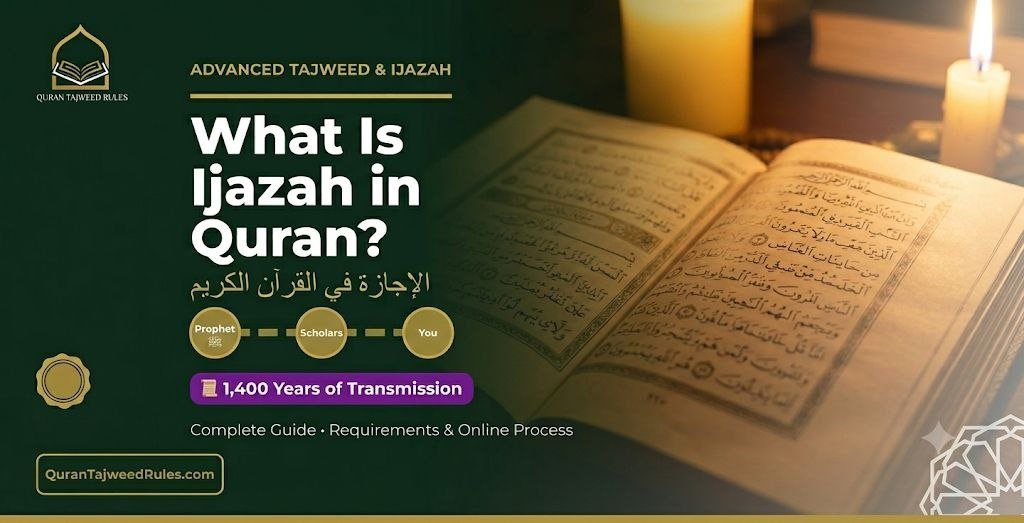
Of all the questions students ask after mastering Tajweed, one carries the most weight: what is Ijazah in Quran? The answer connects you to one of the most extraordinary traditions in Islamic scholarship — an unbroken chain of oral transmission that links every certified reciter directly to the Prophet Muhammad صلى الله عليه وسلم through every generation of scholars in between.
Ijazah is not simply a certificate. It is an authorization — a verified declaration that your recitation has been examined, approved, and transmitted by a qualified scholar whose own recitation was similarly examined and approved in an unbroken chain going back 1,400 years.
This complete guide answers every dimension of what Ijazah in Quran is — its definition, its history, its requirements, the process of obtaining one online, who should pursue it, and how Quran Tajweed Rules Academy makes this extraordinary certification accessible to Muslims everywhere.
|
What You Will Learn in This Guide The precise meaning of Ijazah in Quran • The history of Ijazah and the chain of transmission • The 7 components of Ijazah • Requirements for obtaining an Ijazah online • The complete step-by-step process • Who should pursue Ijazah and when • The full learning pathway from beginner to Ijazah |
What Is Ijazah in Quran? The Precise Definition
The word Ijazah (إجازة) comes from the Arabic root meaning “to permit” or “to authorize.” In the context of Quran recitation, Ijazah in Quran is a formal authorization granted by a qualified scholar (Sheikh or Sheikha) to a student who has demonstrated the ability to recite the complete Quran with correct Tajweed, attesting that the student’s recitation has been verified and approved.
But Ijazah is more than an authorization — it is a chain of transmission (Isnad). When a Sheikh grants you Ijazah, your name is added to a documented chain of reciters that connects you directly to the Prophet صلى الله عليه وسلم through every scholar in between. This chain typically consists of 20-30 scholars, each of whom received and granted Ijazah in an unbroken oral tradition.
|
The Most Concise Answer to What Is Ijazah in Quran Ijazah is the formal verification that your Quran recitation with Tajweed has been examined by a scholar holding an authenticated chain of transmission from the Prophet صلى الله عليه وسلم, and that you are now authorized to recite and teach the Quran with that same chain of transmission attached to your name. |
What Is Ijazah in Quran’s History? 1,400 Years of Unbroken Transmission
Understanding what Ijazah in Quran is requires understanding its historical roots. Ijazah is not a modern innovation — it is the original mechanism by which the Quran has been preserved.
The Origin: From the Prophet صلى الله عليه وسلم to His Companions
The Quran was revealed to the Prophet صلى الله عليه وسلم through Jibreel عليه السلام with specific recitation sounds and rules. The Prophet then recited it to his Companions — mouth to ear — and those Companions recited it to their students in the same direct oral manner. This is the original Ijazah in Quran: a direct, verified transmission of the exact sounds and rules of Quranic recitation.
The Formalization: How Ijazah Became a Documented System
As the Islamic world expanded and communities of reciters developed in different regions, scholars began documenting the chains of transmission to ensure authenticity. By the 3rd century of the Islamic calendar, the Ijazah system was formalized: every certified reciter held a written and oral chain tracing their transmission back to the Prophet صلى الله عليه وسلم. This is the Ijazah system that continues unchanged to this day.
The Preservation: Why Ijazah Is the Quran’s Greatest Protection
The written text of the Quran — the Mushaf — preserves the words. The Ijazah system preserves the sounds. No other religious text in human history has a parallel system of verified oral transmission. The Ijazah ensures that the way the Quran is recited today — every Madd length, every Qalqalah echo, every Ghunnah nasal tone — is identical to the way the Prophet صلى الله عليه وسلم recited it.
What Is Ijazah in Quran Made Of? The 7 Essential Components
A complete understanding of what Ijazah in Quran is requires knowing its 7 essential components:
Component 1: The Isnad — The Chain of Transmission
The Isnad (إسناد) is the documented chain of scholars through whom the Ijazah has been transmitted from the Prophet صلى الله عليه وسلم to the granting Sheikh and then to the student. When your Sheikh grants you Ijazah, he provides you with a written Isnad document listing every scholar in the chain. This document is one of the most treasured possessions of a Quran reciter.
Component 2: The Qiraat Specification
Every Ijazah in Quran specifies which Qiraat (recitation style) it authorizes. The most common is Hafs ‘An ‘Asim — the recitation style used by the vast majority of Muslims worldwide. Other Ijazat may be granted in Warsh, Qalun, or any of the other 10 authentic Qiraat. An Ijazah in Hafs does not automatically authorize the recitation of Warsh — each Qiraat requires its own Ijazah.
Component 3: The Complete Quran Recitation
To obtain Ijazah in Quran, the student must recite the complete Quran — all 30 Juz, from Al-Fatiha to An-Nas — to the granting Sheikh with correct Tajweed throughout. The Sheikh listens carefully, identifies and notes any errors, and corrects them before proceeding. This process is typically conducted across multiple sessions.
Component 4: Tajweed Verification
The Sheikh does not simply listen to the student recite — he or she actively verifies the correctness of Tajweed at every level: Makharij, Noon Sakinah rules, Madd lengths, Qalqalah, Ghunnah, Waqf, and all advanced rules. This is why what Ijazah in Quran represents is not just memorization — it is verified, certified mastery of the complete science of Tajweed in practice.
Component 5: The Permission to Teach and Grant Ijazah
Upon receiving Ijazah in Quran, the student is formally authorized to teach Quran recitation and to grant Ijazah to their own students who meet the requirements. This permission is explicit in the Ijazah document and is the mechanism by which the chain of transmission continues to expand with every new generation of certified reciters.
Component 6: The Written Ijazah Certificate
The formal Ijazah certificate is a document that includes: the student’s name, the Sheikh’s name and certification, the complete Isnad chain, the Qiraat authorized, the date and location of the final examination, and the formal declaration of authorization. This document is internationally recognized by Islamic institutions and is the official record of the student’s certification.
Component 7: The Ongoing Responsibility
Receiving Ijazah in Quran carries an ongoing responsibility: to transmit what has been received accurately, to teach with the same care and precision that one’s own Sheikh demonstrated, and to continue the chain of transmission for future generations. Ijazah is not the end of the Quran journey — it is the beginning of a new role as a link in the chain.
What Are the Requirements for Ijazah in Quran?
Understanding what Ijazah in Quran requires helps students plan their journey realistically. Here are the core requirements:
|
Requirement |
Details |
Timeline |
|
Hifz (Memorization) |
Complete memorization of the entire Quran (30 Juz) is typically required |
2-5 years for most students |
|
Tajweed Mastery |
All rules must be applied correctly and automatically throughout the entire Quran |
6-18 months after completing Hifz |
|
Certified Teacher |
Work with an Ijazah-holding Sheikh who can examine and certify |
Ongoing throughout the process |
|
Complete Recitation |
Recite the entire Quran to the Sheikh with verified Tajweed |
Multiple sessions over weeks or months |
|
Error Correction |
All Tajweed errors identified during recitation must be corrected before proceeding |
Addressed in each session |
|
Do I Need Full Hifz for Ijazah? While full Hifz (memorization of the complete Quran) is the traditional requirement, some scholars grant what is known as a “recitation Ijazah” to students who can recite from the Mushaf (reading) rather than purely from memory, provided their Tajweed is verified at the same standard. At Quran Tajweed Rules Academy, we can discuss both pathways depending on your goals and current level. |
How to Get Ijazah in Quran Online: The Complete Step-by-Step Process
The question of how to get Ijazah in Quran online is one that many students assume is impossible — surely such a significant certification requires an in-person examination? In fact, the online Ijazah process at reputable academies like Quran Tajweed Rules Academy is fully authentic, with a verified chain of transmission, live examination, and formally issued certificate.
Step 1: Complete the Beginners Tajweed Foundation
Before any student can begin Ijazah preparation, the foundational Tajweed must be solid. Students who have not yet studied Tajweed formally begin with the Quran Tajweed Course for Beginners, which establishes Makharij and all 7 essential Tajweed rules. Without this foundation, Ijazah preparation is not possible.
|
The foundational guide to understanding Tajweed — what it is, its rules, and why it is the prerequisite for every student pursuing Ijazah in Quran. |
 What Is Tajweed? The Complete 7-Part Guide
Step 2: Complete the Advanced Tajweed Rules Course
Ijazah-level Tajweed goes significantly beyond the 7 essential beginner rules. The Advanced Quran Tajweed Rules Course at Quran Tajweed Rules Academy covers all advanced Madd types, Sifaat Al-Huruf (letter characteristics), advanced Tafkhim and Tarqiq, and the level of Tajweed precision required for Ijazah examination. Most students spend 6-12 months in the Advanced course before being ready for Ijazah preparation.
Step 3: Establish or Complete Quran Memorization
For students pursuing full Ijazah, the Quran memorization (Hifz) process must be well established or complete. Students who have already memorized the Quran can proceed directly to Ijazah examination. Students currently memorizing can begin Ijazah preparation for the portions they have memorized while continuing their memorization in parallel.
Step 4: Begin Ijazah Preparation Sessions
Ijazah preparation at Quran Tajweed Rules Academy consists of one-on-one sessions with an Ijazah-holding Sheikh. In these sessions, the student recites the Quran portion by portion while the Sheikh listens, identifies errors, and corrects them. The Sheikh evaluates Tajweed precision at the Ijazah standard — which is higher than the beginner or advanced course standard.
Step 5: The Formal Ijazah Examination
The formal examination for Ijazah in Quran consists of the student reciting the complete Quran to the Sheikh in a series of live online sessions. The Sheikh listens with full attention, noting any Tajweed errors. At the conclusion, the Sheikh formally declares the student’s recitation approved and issues the Ijazah.
Step 6: Receiving the Ijazah Certificate and Isnad
Upon successful completion, the student receives: a formal Ijazah certificate in their name, the complete Isnad document listing the chain of transmission from the Prophet صلى الله عليه وسلم through the Sheikh to the student, and formal authorization to teach Quran recitation and grant Ijazah to others. The certificate is internationally recognized by Islamic institutions.
Who Should Pursue Ijazah in Quran? Is It Right for You?
Understanding what Ijazah in Quran is naturally raises the question: is it something every Muslim should pursue? The honest answer is: not necessarily — but for those who are called to it, it is one of the most meaningful achievements in a Muslim’s life.
Ijazah Is Ideal For
- Muslims who have memorized or are memorizing the Quran and want to verify their recitation through a certified chain
- Teachers and Imams who want formal authorization to teach Quran and transmit Ijazah to their students
- Serious Tajweed students who have completed advanced study and are ready for the highest level of certification
- Muslims who feel a deep personal connection to the tradition of Quranic transmission and want to be part of the chain
- Sisters who want to become certified female Quran teachers with a verified chain of transmission
Ijazah Is Not Yet Suitable For
- Students who have not yet completed foundational Tajweed — Ijazah requires Tajweed mastery, not just knowledge
- Students who have not established Quran memorization — memorization is the traditional prerequisite
- Students who are in the early stages of their Quran journey — Ijazah is the pinnacle, not the starting point
|
The Realistic Timeline to Ijazah Beginners Tajweed course: 3-6 months Advanced Tajweed course: 6-12 months Quran memorization (if not yet complete): 2-5 years Ijazah preparation and examination: 6-18 months Total realistic timeline for a student starting from zero: 4-7 years of consistent, dedicated study. For students who already have Hifz and solid Tajweed: 1-2 years. |
The Complete Learning Pathway to Ijazah at Quran Tajweed Rules Academy
At Quran Tajweed Rules Academy, every step of the pathway to Ijazah in Quran is available in a single, trusted academy with consistent teacher quality throughout:
|
STEP 1 — Quran Tajweed Course for Beginners Master all 7 essential Tajweed rules — the prerequisite for everything that follows. What you get: ✓ Complete Makharij Al-Huruf curriculum from lesson one ✓ All 7 Tajweed rules with real Quranic examples ✓ Al-Azhar certified teachers specializing in non-Arabic speakers ✓ One-on-one real-time pronunciation correction ✓ 20 hours of structured lessons ✓ Free trial class available |
 FOUNDATION
 qurantajweedrules.com/quran-tajweed-course-for-beginners
|
STEP 2 — Advanced Quran Tajweed Rules Course Master every advanced Tajweed rule at the level required for Ijazah preparation. What you get: ✓ All advanced Madd types: Lazim, Arid, Badal, Tamkeen, Leen ✓ Sifaat Al-Huruf — all 17 letter characteristics ✓ Tafkhim and Tarqiq at Ijazah-standard precision ✓ Full Surah recitations reviewed by senior Al-Azhar scholars ✓ 24 hours of advanced one-on-one instruction ✓ Ijazah preparation pathway guidance |
 ADVANCED
|
STEP 3 — Quran Ijazah in Hafs Online Course The gold standard of Quranic recitation certification — now fully available online. What you get: ✓ One-on-one sessions with an Ijazah-holding Sheikh ✓ Complete Quran recitation verified with Tajweed at Ijazah standard ✓ Formal Ijazah certificate internationally recognized ✓ Complete Isnad document — your chain to the Prophet صلى الله عليه وسلم ✓ Authorization to teach and grant Ijazah to others ✓ Available for brothers and sisters (female Sheikhas available) |
 CERTIFICATION
|
STEP 4 — 10 Qiraat Course Optional. For the most dedicated students of the complete Quranic tradition. What you get: ✓ All 10 authentic Qiraat beyond Hafs — Warsh, Qalun, Al-Duri, and more ✓ Each Qiraat with its unique rules and verified chain of transmission ✓ Senior Al-Azhar scholars holding Ijazat in multiple Qiraat ✓ Formal Ijazah in multiple Qiraat upon completion |
 MASTERY
Related Guides: Build Your Knowledge Toward Ijazah
|
The foundational rules every student must master before beginning the journey toward Ijazah in Quran. Read: qurantajweedrules.com/essential-tajweed-rules-for-beginners |
|
The Makharij foundation that is verified at Ijazah standard — correct letter articulation from every one of the 17 articulation points. |
|
The 4 Noon Sakinah rules that must be applied with perfect consistency throughout the entire Quran for Ijazah. |
|
The 3 most audible Tajweed rules verified at Ijazah standard — complete with Quranic examples and correct application guidance. |
|
The complete guide to choosing the right online Tajweed course — the first step on the pathway to Ijazah in Quran. Read: qurantajweedrules.com/best-online-tajweed-course-for-beginners |
|
The realistic timeline for every stage of the journey toward Ijazah — from beginner Tajweed through advanced study. Read: qurantajweedrules.com/how-long-does-it-take-to-learn-tajweed |
Frequently Asked Questions: What Is Ijazah in Quran?
Is online Ijazah valid and authentic?
Yes. The authenticity of Ijazah in Quran depends on the chain of transmission and the qualification of the granting Sheikh — not on whether the examination occurs in person or online. A Sheikh holding a verified Isnad who examines a student’s recitation live via video call and verifies its correctness before granting Ijazah is transmitting an authentic, valid Ijazah. The online format does not diminish the chain’s authenticity in any way. Scholars have confirmed this position, noting that what matters is the live transmission, not the physical medium.
What is the difference between Ijazah in Quran and memorizing the Quran?
Memorizing the Quran (Hifz) means storing the complete text in memory so that you can recite it without a Mushaf. Ijazah in Quran means having your recitation — with all its Tajweed rules correctly applied — examined, verified, and certified by a qualified Sheikh in a chain of transmission. Hifz is typically required before pursuing Ijazah, but Hifz alone does not confer Ijazah — the Tajweed examination and certification is a separate, additional process.
What is Ijazah in Hafs specifically?
Ijazah in Hafs refers specifically to Ijazah in the recitation style of Hafs ‘An ‘Asim — the most widely practiced of the 10 authentic Qiraat, used by the vast majority of Muslims worldwide. “Hafs” refers to Hafs Ibn Sulaiman, a student of ‘Asim Ibn Abi Al-Najud, one of the 7 primary Quranic reciters whose chains of transmission were verified and formalized in Islamic scholarship.
Can sisters get an Ijazah in Quran?
Absolutely. Ijazah in Quran for sisters is fully available at Quran Tajweed Rules Academy, including through female Sheikhas holding verified chains of transmission. Sisters who complete the Beginners course, Advanced course, and establish their Hifz can pursue full Ijazah through one-on-one online sessions with a certified female Sheikh. The Isnad and certificate are identical in authority to those granted to male students.
How many people in the world have Ijazah in Quran?
The number of Ijazah holders in Quran globally is estimated at several hundred thousand — a small fraction of the world’s Muslim population. This relative scarcity is a reflection of the genuine requirements: complete Quran memorization with verified Tajweed, examined by a qualified Sheikh. Those who have earned this certification are part of an extraordinary scholarly tradition.
Begin Your Journey Toward Ijazah in Quran Today
Now you know what Ijazah in Quran is — its meaning, its history, its 7 components, its requirements, and the process of obtaining one online. Whether you are just beginning your Quran journey or already well advanced, the pathway to Ijazah is clear, structured, and fully supported at Quran Tajweed Rules Academy.
Ijazah is not just a certificate. It is a connection — to the Prophet ﷺ, to 1,400 years of scholars, to the most perfectly preserved text in human history. It is a responsibility to transmit what you have received with the same care and precision with which you received it.
Your journey begins with a single lesson. And that lesson is free.
|
Start Your Journey Toward Ijazah in Quran Whether you are at the beginning of your Tajweed journey or preparing for Ijazah, Quran Tajweed Rules Academy has the course, teacher, and pathway for you. Begin with a free trial class — no payment, no commitment. Visit: qurantajweedrules.com/freetrial |
7 Responses