
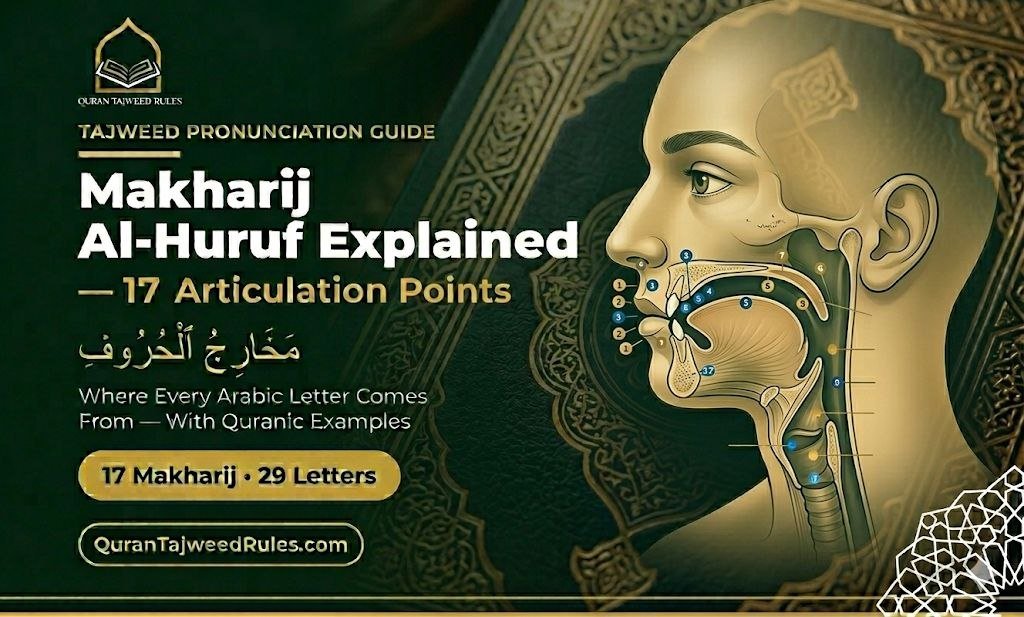
Makharij Al-Huruf (مخارج الحروف) — the articulation points of Arabic letters — is the single most important foundation of Tajweed. It is also the most commonly skipped step by beginners.
Every Tajweed rule you will ever learn — Noon Sakinah, Madd, Qalqalah, Ghunnah — sits on top of Makharij Al-Huruf. If your letter articulation is incorrect, every rule you apply will also be incorrect, no matter how well you understand it in theory.
The Arabic language has 29 letters. Each one comes from a precise, specific location in the mouth or throat — its Makhraj (singular of Makharij). Producing a letter from the wrong location changes the sound, changes the meaning, and changes the Quran. This is why scholars of Tajweed have always taught Makharij Al-Huruf as the first and most essential step in learning to recite correctly.
This guide gives you a complete, clear explanation of all 17 Makharij (articulation zones) with real Quranic examples for each — plus practical tips for improving your own letter pronunciation starting today.
|
What You Will Learn in This Guide What Makharij Al-Huruf means and why it is the foundation of all Tajweed • The 5 main areas of articulation and their 17 specific points • Real Quranic examples for each Makhraj • The most common Makharij errors non-Arabic speakers make • How to practice and correct your Makharij effectively |
|
Before diving into Makharij Al-Huruf in depth, make sure you understand the broader Tajweed framework. Our complete beginners’ guide covers all 7 essential rules and how Makharij fits into the larger picture. Link: qurantajweedrules.com/essential-tajweed-rules-for-beginners |
 Related Article: 7 Essential Tajweed Rules for Beginners
What Is Makharij Al-Huruf? The Foundation of Correct Tajweed
The word Makhraj (مخرج) is Arabic for “exit” or “out-put.” In the science of Tajweed, Makharij Al-Huruf refers to the precise exit points — the specific locations in the mouth, throat, or nasal passage from which each Arabic letter is produced.
Think of it this way: your mouth is an instrument. Just as every key on a piano produces a specific, unique note, every Arabic letter is produced at a specific, unique point of articulation. Press the wrong key and you play the wrong note. Articulate from the wrong point and you produce the wrong letter.
There are 17 specific Makharij (articulation points) in classical Tajweed, grouped under 5 main areas of the body:
- الجوف Al-Jawf — The Oral and Throat Cavity (for elongation sounds)
- الحلق Al-Halq — The Throat (3 specific points, 6 letters)
- اللسان Al-Lisan — The Tongue (10 specific points, 18 letters)
- الشفتان Al-Shafatain — The Two Lips (2 points, 4 letters)
- الخيشوم Al-Khayshum — The Nasal Passage (1 point, Ghunnah sounds)
|
Why Makharij Al-Huruf Cannot Be Skipped A student who learns Noon Sakinah rules without correct Makharij will apply the rules to a Noon that is already mispronounced — and the result will still be incorrect recitation. Makharij is not a preliminary chapter to rush through. It is the foundation that determines the quality of everything built on top of it. |
The 5 Main Areas of Makharij Al-Huruf
Before exploring each of the 17 specific Makharij Al-Huruf, it is essential to understand the 5 main areas from which Arabic letters are produced. These 5 areas form the map that guides your understanding of every individual articulation point.
Area 1: Al-Jawf (الجوف) — The Empty Oral and Throat Cavity
Al-Jawf refers to the open, empty space inside the mouth and throat. It is not a physical contact point — unlike other Makharij, no part of the tongue, lip, or throat touches another surface. Instead, the sound resonates freely through the open cavity.
Al-Jawf is the Makhraj for the three Madd (elongation) letters when they appear without a vowel of their own:
- الألف Al-Alif (ا) — the long “aa” sound, preceded by a Fatha vowel
- الواو Al-Waw (و) with Sukoon — the long “oo” sound, preceded by a Damma vowel
- الياء Al-Ya (ي) with Sukoon — the long “ee” sound, preceded by a Kasra vowel
|
Quranic Example: Al-Jawf بِسْمِ اللَّهِ الرَّحْمَٰنِ الرَّحِيمِ (Bismillah Al-Rahman Al-Raheem). The ا in Al-Rahman and Al-Raheem, the ا in Bismillah — all produced from Al-Jawf with open resonance. Feel the openness of your throat and mouth as these sounds flow freely, unrestricted by any contact point. |
Area 2: Al-Halq (الحلق) — The Throat (3 Points, 6 Letters)
Al-Halq (the throat) contains 3 specific Makharij producing 6 of the most challenging Arabic letters for non-Arabic speakers. These letters are often called the “throat letters” and appear in the Izhar rule for Noon Sakinah.
|
Arabic Letters |
Articulation Point |
Example Word |
|
ء ه (Hamzah, Ha) |
Deepest throat (Aqsal Halq) |
هَلْ (hal) — Did he? |
|
ع ح (‘Ain, Ha) |
Middle throat (Wasat Al-Halq) |
عَلِمَ (alima) — He knew |
|
غ خ (Ghain, Kha) |
Upper throat (Adna Al-Halq) |
غَيْب (ghayb) — Unseen |
Practical tip for the throat letters: Place your hand lightly on your throat while practicing. For ع (Ain) and ح (Ha), you should feel a constriction in the mid-throat — a slight squeezing that produces the distinctive Arabic sound. For غ (Ghain) and خ (Kha), the sound comes from slightly higher, near where the throat meets the back of the mouth. For non-Arabic speakers, these sounds feel unusual at first but become natural with consistent daily practice.
Area 3: Al-Lisan (اللسان) — The Tongue (10 Points, 18 Letters)
The tongue is the most productive area of Makharij Al-Huruf, containing 10 of the 17 articulation points and producing 18 Arabic letters. Different parts of the tongue — its tip, blade, sides, middle, and back — combine with different parts of the upper mouth to produce each unique sound.
Back of Tongue (2 Points)
|
Arabic Letters |
Articulation Point |
Example Word |
|
ق (Qaf) |
Back of tongue against soft palate (highest point) |
قُلْ (qul) — Say (Surah Al-Ikhlas) |
|
ك (Kaf) |
Back of tongue against soft palate (slightly forward) |
كَلَّا (kalla) — No indeed |
|
Common Error: Qaf vs Kaf The ق (Qaf) is produced from the very back of the tongue pressing against the uvular area of the soft palate — deeper than the ك (Kaf). Many non-Arabic speakers produce both from the same position, making them sound identical. In the Quran, قلب (qalb, heart) and كلب (kalb, dog) differ only in this one position. Getting this Makhraj right is critical for meaning accuracy. |
Middle of Tongue (3 Points)
|
Arabic Letters |
Articulation Point |
Example Word |
|
ج ش ي (Jim, Shin, Ya) |
Middle of tongue against hard palate |
جَنَّة (jannah) — Paradise |
Side of Tongue (2 Points)
|
Arabic Letters |
Articulation Point |
Example Word |
|
ض (Dad) |
Left or right side of tongue against upper molars |
ضَآلِّينَ (daalleen) — Those who are astray (Al-Fatiha) |
|
ل (Lam) |
Side tip of tongue against upper gum ridge |
اللَّه (Allah) — Allah |
|
Quranic Example: Dad (ض) in Al-Fatiha The letter ض (Dad) appears in the last verse of Surah Al-Fatiha: غَيْرِ الْمَغْضوبِ عَلَيْهِمْ (not of those who have incurred anger). The ض must come from the side of the tongue pressing against the upper back teeth — NOT from the front of the tongue like a D or TH sound. This is one of the most frequently mispronounced letters in Al-Fatiha, which Muslims recite at least 17 times daily. |
Tip of Tongue (3 Points)
|
Arabic Letters |
Articulation Point |
Example Word |
|
ن (Noon) |
Tip of tongue against upper gum ridge (like L but nasalized) |
نَعْبُدُ (na‘budu) — We worship (Al-Fatiha) |
|
ر (Ra) |
Tip of tongue, slightly rolled against gum ridge |
رَبِّ (rabbi) — My Lord |
|
د ذ ث ص ز س ش ظ ط ت (6 letters) |
Various tip positions |
Multiple |
Gum-Tip and Dental Letters (Detail)
The 6 dental and sibilant letters from the tip of the tongue deserve special attention because they are frequently confused:
|
Arabic Letters |
Articulation Point |
Example Word |
|
ت د ط (Ta, Dal, Ta) |
Tip of tongue against back of upper front teeth |
تَبَّتْ (tabbat) — May it perish (Surah Al-Masad) |
|
ث ذ ظ (Tha, Dhal, Dha) |
Tip of tongue between upper and lower front teeth |
ظَلَمَ (zalama) — He wronged |
|
ص ز س (Sad, Zayn, Sin) |
Tip of tongue near (not touching) upper teeth |
سَبيلَ (sabeel) — Path |
Area 4: Al-Shafatain (الشفتان) — The Two Lips (2 Points, 4 Letters)
Al-Shafatain (the two lips) is the most intuitive area of Makharij Al-Huruf for non-Arabic speakers because it contains sounds that are closely related to sounds in English and other languages.
|
Arabic Letters |
Articulation Point |
Example Word |
|
ب (Ba) |
Both lips pressed together firmly, then released |
بِسْمِ (Bismi) — In the name of (Al-Fatiha) |
|
م (Meem) |
Both lips pressed together lightly (with nasal resonance) |
Meem in الرَحْمَٰنِ (Al-Rahman) |
|
و (Waw) |
Both lips rounded outward without touching |
وَ اللَّهِ (wa-Allah) — And Allah |
|
ف (Fa) |
Upper front teeth lightly touching lower lip |
فَلَمَّا (falamma) — Then when |
|
Practical Tip: Ba vs Meem vs Waw All three letters involve the lips, which is why they are easily confused. ب (Ba): lips press firmly together and release with a clear stop sound. م (Meem): lips press lightly together with nasal resonance flowing through the nose. و (Waw): lips round outward into an “oo” shape without touching. Practice these three in sequence — Ba, Meem, Waw — and feel the distinct difference in lip position each time. |
Area 5: Al-Khayshum (الخيشوم) — The Nasal Passage (Ghunnah)
Al-Khayshum is the nasal passage — the channel through the nose through which Ghunnah (the nasal resonance sound) is produced. It is the only Makhraj that does not involve the mouth, tongue, or throat directly.
Ghunnah is not the sound of a specific letter — it is a characteristic applied to the letters ن (Noon) and م (Meem) in specific conditions. Whenever you see Noon or Meem with Shaddah, or in the Idgham or Ikhfa conditions, the nasal passage becomes the Makhraj for the resonating sound.
|
Quranic Example: Al-Khayshum إنَّا أعْطَيْنَاكَ الْكَوْثَرَ (Inna a‘taynaka al-kawthar) — Surah Al-Kawthar 108:1. The نّ (Noon with Shaddah) in إنَّا requires a full 2-count Ghunnah from Al-Khayshum. Place two fingers lightly on the sides of your nose while reciting. You must feel a vibration. If you feel nothing, the nasal passage is not engaged and the Ghunnah is absent. |
Makharij Al-Huruf: Complete Reference Table of All 17 Articulation Points
This comprehensive table gives you the complete Makharij Al-Huruf reference for all 29 Arabic letters, organized by their 5 main areas and 17 specific articulation points.
|
Area |
Specific Makhraj |
Letters |
Description |
|
Al-Jawf |
Open Cavity (1 point) |
ا و ي (Madd forms) |
Free resonance, no contact point |
|
Al-Halq |
Deep throat |
ء ه |
Deepest part of throat |
|
Al-Halq |
Mid-throat |
ع ح |
Middle throat constriction |
|
Al-Halq |
Upper throat |
غ خ |
Near throat-mouth junction |
|
Al-Lisan |
Back tongue vs soft palate (deep) |
ق |
Deepest back-tongue contact |
|
Al-Lisan |
Back tongue vs soft palate (forward) |
ك |
Slightly forward from Qaf |
|
Al-Lisan |
Mid tongue vs hard palate |
ج ش ي |
Center of tongue arches up |
|
Al-Lisan |
Side tongue vs upper molars |
ض |
Widest letter — side contact |
|
Al-Lisan |
Side-tip tongue vs upper gum |
ل |
Lateral, near front gum |
|
Al-Lisan |
Tip tongue vs gum ridge (nasal) |
ن |
Similar to L but nasalized |
|
Al-Lisan |
Tip tongue vs gum ridge (rolled) |
ر |
Slightly trilled |
|
Al-Lisan |
Tip tongue vs back of upper teeth |
ت د ط |
Dental stops |
|
Al-Lisan |
Tip tongue between teeth |
ث ذ ظ |
Interdental sounds |
|
Al-Lisan |
Tip tongue near upper teeth (no touch) |
ص ز س |
Sibilant sounds |
|
Al-Shafatain |
Both lips together (firm) |
ب |
Bilabial stop |
|
Al-Shafatain |
Both lips together (soft) + nose |
م |
Bilabial nasal |
|
Al-Shafatain |
Lips round outward |
و |
Bilabial approximant |
|
Al-Shafatain |
Upper teeth + lower lip |
ف |
Labiodental fricative |
|
Al-Khayshum |
Nasal passage |
Ghunnah (N/M in specific conditions) |
Nasal resonance only |
Common Makharij Al-Huruf Mistakes Non-Arabic Speakers Make
Understanding Makharij Al-Huruf in theory is valuable. But knowing the most common mistakes gives you an immediate practical advantage. These are the errors that appear most frequently in students who come to us from English-speaking, Urdu-speaking, and other non-Arabic speaking backgrounds.
Mistake 1: Pronouncing ع (Ain) as a Regular Vowel
The letter ع (Ain) has no equivalent in English. It is a voiced pharyngeal consonant produced by constricting the mid-throat. Many beginners either skip it entirely (treating it as a glottal stop like ء) or as a simple vowel sound. This changes the meaning of every word containing Ain — including critical Quranic words like عَلَيْهِمْ (upon them) in Al-Fatiha, which Muslims recite at least 17 times daily.
Mistake 2: Producing ق (Qaf) from the Same Position as ك (Kaf)
ق (Qaf) must come from the very back of the tongue, touching the uvular area of the soft palate. ك (Kaf) comes from slightly forward on the same palate. When both are produced from the same position, the letters sound identical — and the Quran’s precision is lost. As noted earlier, قلب (qalb, heart) becomes كلب (kalb, dog) with this error.
Mistake 3: Replacing ث (Tha) with س (Sin) or ت (Ta)
English speakers often replace ث (Tha) — the interdental sound where the tongue tip goes between the teeth — with either س (Sin) or ت (Ta), because English’s “th” sound is not consistently the same as Arabic ث. This error appears frequently in words like ثَلَاثَة (three) and affects recitation accuracy throughout the Quran.
Mistake 4: Producing ض (Dad) as a D or Z Sound
ض (Dad) is one of the most unique sounds in Arabic — so unique that Arabic is sometimes called “Lughat Al-Dad” (the language of the Dad). It is produced from the side of the tongue pressing against the upper molars, with a specific heaviness. Most non-Arabic speakers substitute a simple D or DZ sound, which is completely different in both Makhraj and sonic quality.
Mistake 5: Skipping Makharij Entirely and Moving Straight to Rules
The most damaging mistake of all — and the one this entire section exists to prevent. Students who learn Tajweed rules for beginners without first establishing correct Makharij Al-Huruf are building on a faulty foundation. Every rule they apply will be applied to incorrectly produced letters. The result is Tajweed-rule-compliant recitation that is still phonetically incorrect — which is worse than no Tajweed knowledge at all, because the student believes they are reciting correctly.
How to Practice and Improve Your Makharij Al-Huruf Effectively
Knowing the theory of Makharij Al-Huruf is the first step. Building correct articulation into your automatic recitation requires structured practice. Here is a proven approach:
Step 1: Isolate Each Letter and Locate Its Makhraj
For each Arabic letter, follow this process: Say the letter slowly. Then stop immediately after producing the sound. Notice exactly where your tongue, lips, or throat are at the moment of peak sound production. Compare this to the Makhraj description above. If the position does not match, adjust and try again.
Step 2: Practice Each Letter with Three Vowel Sounds
Each Arabic letter should be practiced with all three short vowels (Fatha, Kasra, Damma) to ensure the Makhraj remains consistent regardless of the vowel following it. For example, practice قَ (Qa), قِ (Qi), and قُ (Qu) and ensure the back-tongue contact point does not shift between the three.
Step 3: Listen to Certified Reciters and Isolate Letters
Select a certified reciter known for Tajweed precision (such as Sheikh Mahmoud Khalil Al-Husary, whose slow Muallim recordings are specifically designed for learning). Listen to individual letters and short words, pausing and repeating until your production matches what you hear.
Step 4: Record Yourself and Compare
Record yourself producing each letter and then play back the recording. Compare your sound to a reference recording. Errors that are invisible during active recitation often become audible in a recording. Focus your next practice session on the specific letters where you hear a difference.
Step 5: Learn with a Certified Teacher Who Can Hear Your Makhraj
All of the above steps are valuable — and they are also limited. You cannot hear your own Makhraj errors with the same clarity that a trained teacher can. A qualified teacher with proper Tajweed certification will identify your specific Makhraj weaknesses in the first lesson and give you targeted correction that would take months of self-correction to achieve alone.
Start Mastering Makharij Al-Huruf with the Right Course at Quran Tajweed Rules
Whether you are a complete beginner or a student who has been reciting for years without formal Makharij training, the courses at Quran Tajweed Rules Academy are designed to build or correct your Makharij Al-Huruf from the foundation.
For Beginners: Quran Tajweed Course for Beginners
Our Beginners course starts with Makharij Al-Huruf in the very first lessons — ensuring that every subsequent rule is applied to correctly produced letters. Taught by Al-Azhar certified Egyptian teachers who specialize in helping non-Arabic speakers, this course builds the foundation that makes all further Tajweed study effective.
|
Structured curriculum starting with Makharij Al-Huruf • Al-Azhar certified teachers • Real-time pronunciation correction • 20 hours of personalized one-on-one lessons • Completion certificate • Free trial class available Link: qurantajweedrules.com/quran-tajweed-course-for-beginners |
 Quran Tajweed Course for Beginners
For Students Who Have Already Started: Advanced Quran Tajweed Rules
Already familiar with the basic Tajweed rules but want to deepen your Makharij accuracy and master the advanced characteristics of each letter (Sifaat Al-Huruf)? The Advanced course builds on your existing knowledge with precise, detailed study of each letter’s qualities beyond its basic Makhraj.
|
Deep-dive into Sifaat Al-Huruf (letter characteristics) • Advanced Madd, rare Makharij refinements • Preparation pathway for Ijazah • 24 hours with senior Al-Azhar scholars • For students who have completed beginner Tajweed |
For Sisters: Online Tajweed Classes for Sisters
Sisters can learn Makharij Al-Huruf and all Tajweed rules in a private, comfortable environment with qualified female teachers. Our Sisters course offers the same Al-Azhar certified instruction in a setting designed specifically for women learning the Quran.
|
Private one-on-one lessons with qualified female teachers • No-mixing environment • Makharij and full Tajweed curriculum • Flexible scheduling • Free trial class available Link: qurantajweedrules.com/online-tajweed-classes-for-sisters |
For Children: Tajweed Rules for Kids Course
Children who learn Makharij Al-Huruf correctly from a young age develop an enormous advantage in Quran recitation that lasts a lifetime. Our Kids course teaches Makharij through age-appropriate, engaging methods that make letter articulation fun and memorable.
|
Child-friendly Makharij teaching methodology • Interactive and engaging lessons • 20-30 minute sessions designed for children’s attention spans • Al-Azhar certified teachers experienced with children |
Continue Your Tajweed Journey — Related Articles
Makharij Al-Huruf is your foundation. Once your letter articulation is correct, you are ready to build the rules of Tajweed on top of it. These articles from our blog will guide your next steps:
|
Now that you understand Makharij Al-Huruf, discover how all 7 essential Tajweed rules — from Noon Sakinah to Waqf — build on your letter articulation foundation. Includes real Quranic examples for every rule. Link: qurantajweedrules.com/essential-tajweed-rules-for-beginners |
|
Wondering how long your Tajweed journey will take? This guide gives you a realistic, week-by-week timeline based on your starting level, practice time, and learning method — including how Makharij mastery fits into the bigger picture. Link: qurantajweedrules.com/how-long-does-it-take-to-learn-tajweed |
Frequently Asked Questions About Makharij Al-Huruf
How many Makharij Al-Huruf are there?
Classical Tajweed scholars identify 17 specific Makharij (articulation points), grouped under 5 main areas: Al-Jawf (1 point), Al-Halq/Throat (3 points), Al-Lisan/Tongue (10 points), Al-Shafatain/Lips (2 points), and Al-Khayshum/Nasal Passage (1 point). Some scholars count 16 or 14 Makharij using slightly different grouping conventions, but 17 is the most widely accepted number in traditional Tajweed texts.
How long does it take to learn Makharij Al-Huruf correctly?
Most beginners can learn the theoretical positions of all 17 Makharij within 2 to 3 weeks of focused study. Building the correct articulation into automatic, consistent recitation typically takes 4 to 8 weeks of daily practice with a qualified teacher who can give real-time feedback. Students who practice only occasionally may take 3 to 6 months to establish consistent Makharij habits. For more on learning timelines, read our complete guide: How Long Does It Take to Learn Tajweed?
Can I learn Makharij Al-Huruf on my own?
You can learn the theoretical positions of each Makhraj from a guide like this one. However, self-correction of Makharij errors is extremely difficult because you cannot hear your own pronunciation errors as clearly as an external listener can. A qualified teacher will identify your specific Makharij weaknesses in the first lesson and correct them efficiently. Self-study without teacher feedback typically results in incorrect habits becoming solidified over time.
Which Makharij letters are hardest for non-Arabic speakers?
The most challenging Makharij Al-Huruf for non-Arabic speakers are consistently: ع (Ain) — no English equivalent; ح (Ha) — different from the English H; ق (Qaf) — deeper than any English sound; ض (Dad) — a lateral pharyngeal sound unique to Arabic; and خ (Kha) and غ (Ghain) — the voiced and voiceless uvular fricatives. Students who master these 6 letters correctly have crossed the most significant phonetic threshold in Arabic Tajweed learning.
Is Makharij Al-Huruf the same in all Qiraat?
The fundamental Makharij — the physical positions from which letters are produced — are the same across all 10 authentic Qiraat. What varies between Qiraat are certain Sifaat (characteristics) of letters and specific rules of joining, stopping, and elongation. Makharij Al-Huruf is universal to all recitation styles.
Begin Building Your Makharij Al-Huruf Foundation Today
Makharij Al-Huruf is not a preliminary detail to rush past on the way to “real” Tajweed. It is the foundation that determines the quality, accuracy, and beauty of every single letter you recite from the Quran — for the rest of your life.
Every minute you invest in correct Makharij today saves you from months of incorrect-habit correction later. Every letter you learn to produce correctly becomes a permanent building block of your Quran recitation.
The 17 articulation points mapped in this guide give you the complete theoretical framework. What transforms that framework into beautiful, accurate recitation is practice — guided by a qualified teacher who can hear exactly where your Makharij needs correction and help you achieve it efficiently.
At Quran Tajweed Rules Academy, every course begins with Makharij Al-Huruf — because we know it is the only way to build recitation that is truly correct. Book your free trial class today and experience the difference that certified, personalized Makharij instruction makes from your very first lesson.
|
Start Your Free Trial Class Learn Makharij Al-Huruf correctly from day one with a certified Al-Azhar teacher at Quran Tajweed Rules Academy. Available for beginners, advanced students, kids, and sisters. No payment required for your first class. Visit: qurantajweedrules.com/freetrial |
20 Responses