
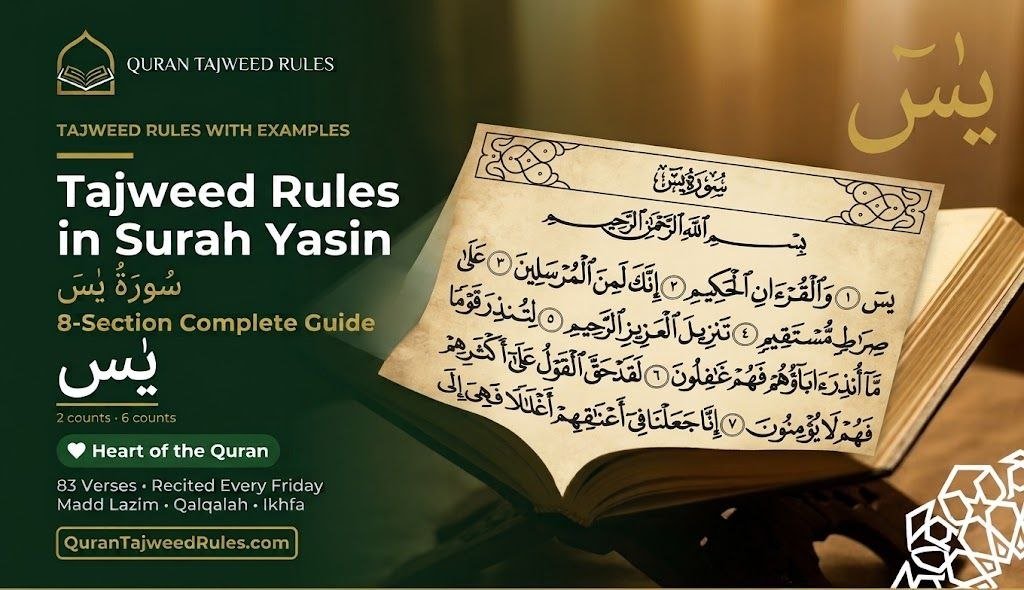
Surah Yasin — called the heart of the Quran in hadith tradition — is one of the most widely recited Surahs in Islam. Its 83 verses are memorized by millions and recited it, for the sick, and in times of difficulty. Yet very few reciters have had its Tajweed rules explained to them systematically, from its opening Huroof Al-Muqattaʿat through its closing verse.
This complete guide to Tajweed rules in Surah Yasin works through the Surah section by section, with scientifically verified Tajweed analysis, precise Makharij descriptions, accurate Quranic text, and common mistakes corrected according to the established principles of the Hafs ʿAn ʿAsim riwayah.
|
What You Will Learn The correct Tajweed of يس — Ya and Seen accurately distinguished • Madd Badal in Al-Qur-aan • Madd Muttasil vs Madd Munfasil • Qalqalah on its 5 letters only • Ikhfa vs Idgham accurately applied • Ta Marbuta Waqf rule • Ra Tafkhim and Tarqiq • Common mistakes corrected |
Section 1: يس — The Huroof Al-Muqattaʿat Opening
The Tajweed rules in Surah Yasin begin immediately with its opening letters يس (Ya Seen). These two letters have different Madd rules that must be understood precisely and distinctly:
|
يس Ya — Seen (each letter recited by its full name) Surah Yasin 36:1 Tajweed Rules:
|
 YA (يا): The letter Ya belongs to the group of Huroof Al-Muqattaʿat known as (حَيٌّْ طَهُرَ). These are letters whose names contain only 2 letters when written — the letter itself and a short vowel. The letter name Ya = Ya + Alif. There is no Madd letter followed by Sukoon in the name Ya; the Alif here is a short connector, not a Madd letter in the Lazim sense. Therefore: Ya is recited with Madd Tabiʿi Harfi (Natural Madd) = 2 counts only.
|
The Key Distinction: حَيٌّْ طَهُرَ Group vs 3-Letter Group Huroof Al-Muqattaʿat divide into two groups by their letter names: 1. Letters with 2-letter names (حَيٌّْ طَهُرَ group: ح ي ط ه ر): Their names contain no Madd letter followed by Sukoon → Madd Tabiʿi Harfi = 2 counts. Ya (يا) belongs here. 2. Letters with 3-letter names containing a Madd letter in the middle: The Madd letter + Sukoon on the last letter → Madd Lazim Harfi = 6 counts. Seen (سين) belongs here. This is why in Alif Lam Meem: Alif = no Madd, Lam = 6 counts, Meem = 6 counts. And in Ya Seen: Ya = 2 counts, Seen = 6 counts. |
|
وَالْقُرْآنِ الْحَكِيمِ Wal-qur-aanil-hakeem Surah Yasin 36:2 Tajweed Rules:
|
|
Madd Badal — Precise Definition Madd Badal (مد بدل): occurs when a Hamzah is followed by a Madd letter in the same word, because the Madd letter substitutes (badal) for a second Hamzah that would have been there originally. Example: آمَنَ = originally Hamzah + Hamzah + Meem. The second Hamzah is replaced by Alif (the Madd letter). Result: Hamzah + Alif Madd (Badal). In Hafs ʿAn ʿAsim: Madd Badal = 2 counts (Qasr — natural Madd length). NOT 4 or 6 counts. IMPORTANT: Madd Badal is completely different from Madd Wajib Muttasil. In Muttasil, the Madd comes BEFORE the Hamzah. In Badal, the Hamzah comes BEFORE the Madd. |
|
The complete Madd system: Lazim Harfi, Muttasil, Munfasil, Badal, Arid — all explained with examples. |
 Advanced Tajweed Rules: The Essential 7-Category Guide
Section 2: Verses 3–12 — The Mission of the Messenger
The opening section establishes the Prophet’s mission and contains several key Tajweed rules in Surah Yasin:
|
إِنَّكَ لَمِنَ الْمُرْسَلِينَ Innaka laminal-mursaleen Surah Yasin 36:3 Tajweed Rules:
|
|
عَلَٰى صِرَٰطمُّسْتَقِيمٍ ʿalaa siraatin mustaqeem Surah Yasin 36:4 Tajweed Rules:
|
|
The 5 Qalqalah Letters — Scientific Precision Qalqalah applies ONLY to these 5 letters when they carry Sukoon: ق (Qaf) | ط (Ta heavy) | ب (Ba) | ج (Jim) | د (Dal) Memory aid: قُطْبُ جَدٍّ (Qutb Jadd) Letters NOT in the Qalqalah group (even with Sukoon): ض (Dad), ث (Tha), ت (Ta light), س (Seen), and all others. A Sukoon on any of these produces plain Sukoon — never Qalqalah. |
|
إِنَّا نَحْنُ نُحْيِ الْمَوْتَىٰ Innaa nahnu nuhyil-mawtaa Surah Yasin 36:12 Tajweed Rules:
|
Section 3: The Story of the People of the Town (Verses 13–29)
This narrative section is rich in Tajweed Surah Yasin applications. Precise Quranic text is essential throughout:
|
واضْرِبْ لَهُم مَثَلؑا أَصْحَٰبَ الْقَرْيَةِ Wadrib lahum mathalan as-habal-qaryah Surah Yasin 36:13 Tajweed Rules:
|
|
Ta Marbuta at Waqf — Always Becomes Ha Sakinah Any word ending in Ta Marbuta (ة) — when paused upon — is pronounced as Ha Sakinah (هْ), not as Ta. Examples in Surah Yasin: • Al-Qaryah (القرية) at pause = Al-Qar-yah • Al-Maytah (الميتة) at pause = Al-May-tah (not Al-May-tat) • Aayatun (آية) at pause = Aa-yah This rule applies universally to all Ta Marbuta at Waqf throughout the Quran. |
|
إِذْ أَرْسَلْنَا إِلَيْهِمُ اثْنَيْنِ فَكَذَّبُوهُمَا فَعَزَّزْنَا بِثَالِثٍ Idh arsalnaa ilayhimu-thnayn fakadhdhaboohumā faʿazzaznā bi-thaalith Surah Yasin 36:14 — Note: the correct text is فَكَذَّبُوهُمَا (with dual pronoun هُمَا), not فَكَذَّبُوا Tajweed Rules:
|
|
Tha (ث) is Mahmus (Unvoiced) — Scientific Clarification The 3 interdental letters in Arabic are: • ث (Tha): Mahmus, Rikhwa — UNVOICED fricative (like English ‘th’ in ‘think’) • ذ (Dhal): Majhur, Rikhwa — VOICED fricative (like English ‘th’ in ‘this’) • ظ (Dha heavy): Majhur, Rikhwa, Istiʿla, Itbaq — VOICED heavy interdental Tha (ث) is Mahmus (voiceless) — never Majhur. |
|
قَالُوا مَا أَنتُمْ إِلَّا بَشَرٌ مِّثْلُنَا Qaaloo maa antum illaa basharum mithlunaa Surah Yasin 36:15 Tajweed Rules:
|
Section 4: Verses 33–44 — Signs of Creation
This section is particularly rich in Madd types and emphatic letters. Accurate Quranic text is essential:
|
وَآيَةٌ لَّهُمُ الْأَرْضُ الْمَيْتَةُ Wa-aayatun lahumul-ardul-maytah Surah Yasin 36:33 Tajweed Rules:
|
|
وَجَعَلْنَا فِيهَا جَنَّٰتٍ مِّن نَّخِيلٍ وَأَعْنَابٍ Wa jaʿalnā feehā jannaatin min nakheelin wa-aʿnaab Surah Yasin 36:34 — Note: correct text is وَجَعَلْنَا (jaʿalnā), not خَلَقْنَا (khalaqnā) Tajweed Rules:
|
|
Ikhfa vs Idgham: The Jim Case A common error is classifying Noon Sakinah before Jim (ج) as Idgham. This is incorrect. The Idgham letters are: ي ن م و ل ر (Yarmalu or similar mnemonics). Jim (ج) is NOT in this group. Noon Sakinah before Jim = Ikhfa Haqiqi: partial concealment of the Noon with a 2-count Ghunnah, then the Jim is articulated. The Noon is not fully merged. |
|
وَالشَّمْسُ تَجْرِي لِمُسْتَقَرٍّ لَّهَا Wash-shamsu tajree li-mustaqarrin lahaa Surah Yasin 36:38 Tajweed Rules:
|
|
وَالْقَمَرَ قَدَّرْنَاهُ مَنَازِلَ حَتَّىٰ عَادَ كَالْعُرْجُونِ الْقَدِيمِ Wal-qamara qaddarnāhu manāzila hattā ʿāda kal-ʿurjoonil-qadeem Surah Yasin 36:39 Tajweed Rules:
|
Section 5: Verses 51–67 — The Day of Resurrection
This section contains important Tajweed Surah Yasin applications including Makharij precision and correct Waqf rules:
|
وَنُفِخَ فِي الصُّورِ فَإِذَا هُم مِّنَ الْأَجْدَاثِ إِلَىٰ رَبِّهِمْ يَنسِلُونَ Wa nufikha fis-soori fa-idhā hum minal-ajdāthi ilā rabbihim yansiloon Surah Yasin 36:51 Tajweed Rules:
|
|
وَامتَازُوا الْيَوْمَ أَيَُّهَا الْمُجْرِمُونَ Wamtaazul-yawma ayyuhal-mujrimoon Surah Yasin 36:59 Tajweed Rules:
|
Section 6: The Closing Verses (Verses 68–83)
The closing section contains the most famous verses of the Surah. Several Tajweed rules in Surah Yasin reach their peak here:
|
فَسُبْحَٰنَ الَّذِي بِيَدِهِ مَلَكُوتُ كُلِّ شَيْءٍ وَإِلَيْهِ تُرْجَعُونَ Fa-subhānal-ladhee biyadihi malakootu kulli shay-in wa ilayhi turjaʿoon Surah Yasin 36:83 Tajweed Rules:
|
The Complete Tajweed Rules Reference Table for Surah Yasin
Comprehensive scientifically verified reference for Tajweed rules in Surah Yasin:
|
Verse(s) |
Tajweed Rule |
Example & Application |
|
36:1 Ya |
Madd Tabiʿi Harfi (2 counts) |
Ya letter name: 2-letter group (حيطهر) — NO Madd Lazim |
|
36:1 Seen |
Madd Lazim Harfi Mukhaffaf (6) |
SEEN: Seen + Ya Madd + Noon Sukoon = 6 counts |
|
36:2 |
Madd Badal (2 counts) |
Al-Qur-AAN: Hamzah before Alif Madd = Madd Badal in Hafs |
|
36:2 |
Madd Asli (2 counts) |
Al-HakEEM: Ya before Meem |
|
36:3 |
Idgham with Ghunnah |
lamin + Al-Mursaleen: Noon Sakinah before Meem = merge + nasal |
|
36:3 |
Madd Arid (Waqf) |
Al-Mursaleen: Ya Madd at pause = 2, 4, or 6 counts |
|
36:4 |
Qalqalah Sughra |
Mustaqeem: ط (Ta heavy) with original Sukoon = minor echo |
|
36:4 |
Makharij ص Saad |
Siraat: Istiʿla + Itbaq. Heavy emphatic |
|
36:13 |
Makharij ض Dad |
Wadrib: lateral emphatic. NO Qalqalah — Dad is not a Qalqalah letter |
|
36:13 |
Ta Marbuta at Waqf |
Al-Qaryah at pause: Ta Marbuta → Ha Sakinah (Al-Qar-yah) |
|
36:14 |
Ikhfa |
min jannaat: Noon Sakinah before Jim = Ikhfa (NOT Idgham) |
|
36:14 |
Idgham same letter |
min nakheelin: Noon before Noon = Idgham Maʿal-Ghunnah |
|
36:14 |
Tha Mahmus (unvoiced) |
Bi-thaalith: Tha is Mahmus — never Majhur |
|
36:33 |
Madd Wajib Muttasil |
wa-AAyatun: Alif + Hamzah in same word (آية) = 4–5 counts |
|
36:33 |
Ta Marbuta at Waqf |
Al-Maytah at pause: Ta Marbuta → Ha Sakinah (Al-May-tah) |
|
36:34 |
Ikhfa |
min jannaat: Noon before Jim = Ikhfa, 2-count Ghunnah |
|
36:34 |
Correct Quranic text |
وَجَعَلْنَا (jaʿalnā), NOT خَلَقْنَا (khalaqnā) |
|
36:38 |
Idgham without Ghunnah |
Mustaqarrin + lahaa: Tanween before Lam = full merge, no nasal |
|
36:39 |
Qalqalah Sughra |
Qaddarnahu: د (Dal) with Sukoon = minor echo |
|
36:51 |
Madd Tabiʿi / Madd Arid |
As-Soor: Waw Madd 2 counts (no Hamzah in word). At Waqf: Madd Arid |
|
36:51 |
Qalqalah Sughra |
Al-Ajdaath: ج (Jim) with Sukoon = minor echo |
|
36:51 |
Tha Mahmus (unvoiced) |
Ajdaath: Tha is Mahmus (unvoiced) — never Majhur |
|
36:51 |
Idgham without Ghunnah |
min rabbihim: Noon before Ra = full merge, no nasal |
|
36:83 |
Madd Muttasil / Madd Leen Arid |
Shay-in: Ya Leen + Hamzah in same word. At Waqf: Madd Leen Arid |
|
36:83 |
Madd Arid (Waqf) |
Turjaʿoon at Waqf: Waw Madd + Noon Sukoon = 2, 4, or 6 counts |
Ra Rules in Surah Yasin: Tafkhim and Tarqiq
|
Ra HEAVY (Mufakhkham) Ra with Fatha: e.g. Rabbihim (36:51) — HEAVY Ra with Damma: e.g. Turjaʿoon (36:83) — HEAVY Ra with Sukoon preceded by Fatha or Damma: HEAVY Ra at beginning of word with Fatha/Damma following: HEAVY |
|
Ra LIGHT (Muraqqaq) Ra with Kasra: LIGHT Ra with Sukoon preceded by Kasra (next letter not heavy): LIGHT Ra with Sukoon preceded by Ya Leen: LIGHT When in doubt: check the vowel on the Ra itself first. |
The 10 Most Common Tajweed Mistakes in Surah Yasin
- Giving Ya in يس (36:1) 6 counts — Ya is Madd Tabiʿi Harfi (2 counts only). Only Seen gets 6 counts (Madd Lazim Harfi Mukhaffaf).
- Treating Al-Qur-AAN (36:2) as Madd Muttasil — correct rule is Madd Badal (2 counts in Hafs).
- Applying Qalqalah to Dad (ض) in Wadrib (36:13) — Dad is NOT a Qalqalah letter. Plain Sukoon with Istitalah.
- Applying Idgham (not Ikhfa) to Noon before Jim — Noon Sakinah before Jim = Ikhfa, not Idgham.
- Calling Tha (ث) Majhur (voiced) — Tha is Mahmus (unvoiced). Always.
- Pausing on Ta Marbuta as Ta (ت) — all Ta Marbuta at Waqf = Ha Sakinah (هْ). Al-Qar-yah, not Al-Qar-yat.
- Claiming Madd Muttasil in As-Soor (36:51) — the word has no Hamzah. Natural Madd 2 counts.
- Missing Qalqalah on ج Jim with Sukoon — Al-Ajdaath (36:51), Al-Mujrimoon (36:59): Jim with Sukoon = Qalqalah Sughra.
- Light Ra where it should be heavy — Ra with Fatha/Damma = always Mufakhkham.
- Reciting خَلَقْنَا instead of جَعَلْنَا in 36:34 — the correct Quranic text is وَجَعَلْنَا.
How to Use Surah Yasin as a Weekly Tajweed Practice
Because Surah Yasin is recited weekly — particularly on Fridays — it provides a natural regular framework for Tajweed Surah Yasin development:
- Week 1: Opening يس — Ya = 2 counts, Seen = 6 counts. Get this precisely right.
- Week 2: Qalqalah — identify every ق, ط, ب, ج, د with Sukoon. Apply Sughra, Kubra, or Akbar level correctly.
- Week 3: Ikhfa vs Idgham — for every Noon Sakinah, identify the following letter’s category precisely.
- Week 4: Ta Marbuta at Waqf — consciously produce Ha Sakinah at every Ta Marbuta pause.
- Week 5+: Ra rules and full integration. Record yourself and review with this guide.
The Complete Learning Pathway
|
STEP 1 — Quran Tajweed Course for Beginners Master all 7 essential rules before approaching Surah Yasin at Tajweed level. What you get: ✓ Makharij for all 29 letters including ع, ح, ص, ض, ق, ط ✓ Noon Sakinah: Izhar, Idgham, Iqlab, Ikhfa — all 4 correctly distinguished ✓ Free trial class available |
 FOUNDATION
 qurantajweedrules.com/quran-tajweed-course-for-beginners
|
STEP 2 — Advanced Quran Tajweed Rules Course Master Madd Lazim Harfi, Madd Badal, Qalqalah levels, and Ra rules. What you get: ✓ Madd Lazim Harfi Mukhaffaf — essential for Seen in يس ✓ Madd Badal (2 counts in Hafs) — essential for Al-Qur-aan ✓ All 3 Qalqalah levels ✓ Complete Ra Tafkhim and Tarqiq rules |
 ADVANCED
|
STEP 3 — Online Ijazah in Hafs Course Have every rule in Surah Yasin — and all 30 Juz — verified by a certified Sheikh. What you get: ✓ All 83 verses at Ijazah standard ✓ Internationally recognized Ijazah certificate and Isnad |
 IJAZAH
Related Guides
|
The foundational Tajweed practice Surah — perfect this before Surah Yasin. Read: qurantajweedrules.com/tajweed-rules-in-surah-al-fatiha |
|
Companion guide for advanced students — Madd Badal, Muttasil, Munfasil applied. Read: qurantajweedrules.com/tajweed-rules-in-surah-al-baqarah |
|
Every challenging letter in Surah Yasin — ع, ح, ص, ض, ج, ث — explained accurately. |
|
All 4 Noon Sakinah rules including the Ikhfa before Jim applied in Surah Yasin. |
|
Madd Lazim Harfi, Madd Badal, Qalqalah levels — all required for Surah Yasin. |
Frequently Asked Questions: Tajweed Rules in Surah Yasin
What is the Madd of Ya in يس?
2 counts (Madd Tabiʿi Harfi). The letter Ya belongs to the حيطهر group — letters whose names have 2 letters with no Madd letter followed by Sukoon. Only Seen gets Madd Lazim Harfi Mukhaffaf (6 counts) because its name SEEN contains Ya Madd + Noon Sakinah.
What is the rule for Al-Qur-AAN in 36:2?
Madd Badal — 2 counts in Hafs ʿAn ʿAsim. The word contains a Hamzah followed by an Alif Madd (the Alif substitutes for a second Hamzah). In Hafs, Madd Badal is recited at Qasr (natural Madd length = 2 counts). It is NOT Madd Wajib Muttasil.
Is there Qalqalah on Dad (ض) with Sukoon?
No. Dad is NOT one of the 5 Qalqalah letters (قطبجد). Dad’s Sifah is Rakhawa (free airflow) — it cannot produce the bouncing echo of Qalqalah. When Dad has Sukoon, recite with plain Sukoon, observing Dad’s characteristics of Istitalah, Istiʿla, Itbaq, and heaviness.
How is Ta Marbuta recited at Waqf?
As Ha Sakinah (هْ). Any word ending in Ta Marbuta — whether Al-Qaryah, Al-Maytah, Rahmah, or any other — when paused upon, is pronounced with Ha Sakinah. Sound: the Ta sound disappears and a soft, unvoiced Ha closes the word.
Perfect Your Surah Yasin Recitation Today
You now have a complete, scientifically verified guide to every Tajweed rule in Surah Yasin — from the 2-count Ya and 6-count Seen of its opening letters, through the precise Ikhfa and Qalqalah of its narrative, to the Madd Arid of its final verse.
A certified Al-Azhar teacher at Quran Tajweed Rules Academy will identify your specific Surah Yasin errors and correct them methodically. Your first lesson is completely free.
|
Book Your Free Trial Class Have your Surah Yasin recitation assessed by a certified Al-Azhar teacher. Every rule verified. Every mistake corrected. First class completely free. Visit: qurantajweedrules.com/freetrial |