
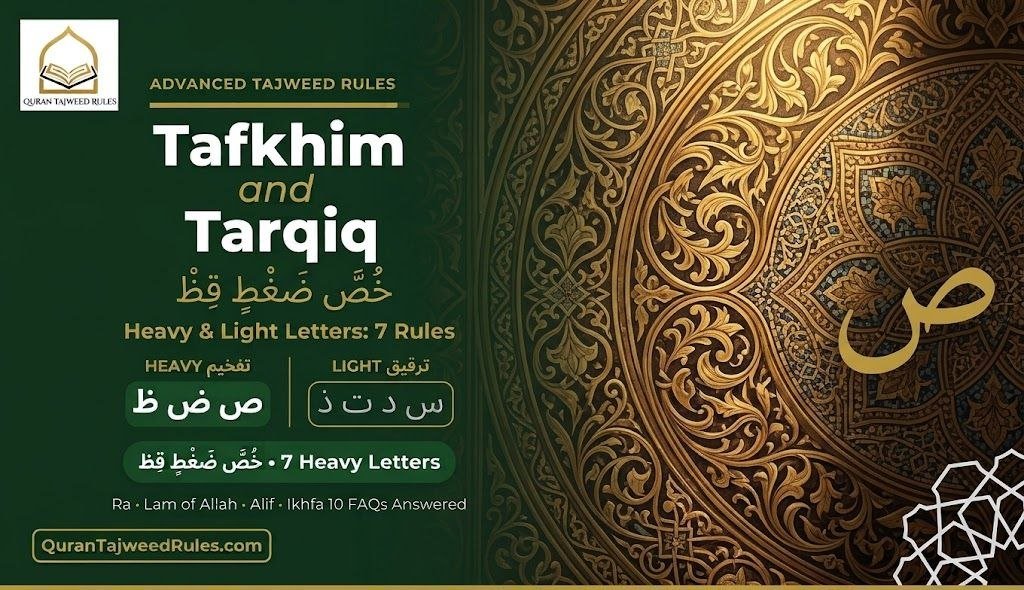
Why do some letters in the Quran sound full, deep and resonant, while others sound light, clear and delicate? The answer is Tafkhim and Tarqiq, one of the most audible and most important sciences in Tajweed. Tafkhim and Tarqiq decide whether a letter is pronounced heavy (with the back of the tongue raised, giving a full, hollow resonance) or light (with the tongue lowered, giving a thin, clear sound).
Applied correctly, Tafkhim and Tarqiq separate a recitation that merely pronounces the words from a recitation that gives every letter its true character. Yet these rules are also among the most misunderstood. Which letters are always heavy? When is the Ra heavy? Why is the Lam in Allah sometimes heavy and sometimes light? Is the Alif heavy or light?
This guide answers all of these questions through 7 clear rules of Tafkhim and Tarqiq, with Quranic examples, reference tables, common mistakes and the 10 most-searched questions, all according to the Hafs ʿan ʿĀṣim riwayah. By the end you will know how to apply Tafkhim and Tarqiq to every letter you recite.
|
What You Will Learn About Tafkhim and Tarqiq The precise definition of Tafkhim and Tarqiq • The 7 heavy letters (Huroof Al-Istiʿla) • The 5 degrees of Tafkhim • How the Alif follows the letter before it • The Lam of Allah: heavy or light • All Ra rules, including Ra Sakin • Heavy and light Ikhfaʾ • 10 common mistakes • The 10 most-searched FAQs • Your learning pathway to Ijazah |
What Are Tafkhim and Tarqiq in Tajweed?
Tafkhim and Tarqiq are the two qualities of letter pronunciation in the science of Tajweed. Every Arabic letter is pronounced either with Tafkhim, with Tarqiq, or, in three special letters, with one or the other depending on the context.
Tafkhim: Making the Letter Heavy
Tafkhim (تَفْخِيم) means “making full” or “thickening.” When a letter is pronounced with Tafkhim, the back of the tongue rises toward the soft palate. This fills the mouth with a deep, hollow resonance. The letter is called Mufakhkham (مُفَخَّم), meaning heavy.
Tarqiq: Making the Letter Light
Tarqiq (تَرْقِيق) means “making thin” or “refining.” When a letter is pronounced with Tarqiq, the tongue stays low and the sound is clear and delicate, with no resonance in the mouth. The letter is called Muraqqaq (مُرَقَّق), meaning light.
Why Tafkhim and Tarqiq Matter in Every Recitation
Tafkhim and Tarqiq are not decorative. Pronouncing a heavy letter as light, such as reciting ص (Saad) as س (Seen), changes the letter itself and can change the word. Understanding Tafkhim and Tarqiq is therefore a core part of correct recitation, taught in every certified Tajweed course.
|
Tafkhim Does Not Mean Louder A common misunderstanding: Tafkhim is about the position of the tongue and the resonance of the letter, not about volume or exaggeration. A heavy letter can be recited quietly and still be fully heavy. Likewise, Tarqiq is not weakness. It is clarity. |
The 7 Rules of Tafkhim and Tarqiq at a Glance
Before exploring each rule in detail, here is the complete map of Tafkhim and Tarqiq:
|
Rule |
Tafkhim and Tarqiq Ruling |
Example |
|
Rule 1 |
7 letters are always heavy (Istiʿla) |
خ ص ض غ ط ق ظ |
|
Rule 2 |
The other letters are light, except Alif, Ra and the Lam of Allah |
ب ت ث ج ح د … |
|
Rule 3 |
The Alif follows the letter before it |
قَالَ (heavy) / كَانَ (light) |
|
Rule 4 |
Lam of Allah: heavy after Fatha or Damma, light after Kasra |
رَسُولُ ٱللَّهِ / بِسْمِ ٱللَّهِ |
|
Rule 5 |
Ra with a vowel: heavy with Fatha or Damma, light with Kasra |
رَبِّ / رِزْق |
|
Rule 6 |
Ra Sakin: depends on the preceding vowel and the following letter |
مَرْيَم / فِرْعَوْن / قِرْطَاس |
|
Rule 7 |
Ikhfaʾ: heavy before 5 letters, light before 10 |
مَن قَتَلَ / مِن شَرِّ |
Rule 1: The 7 Heavy Letters in Tafkhim and Tarqiq (Huroof Al-Istiʿla)
The foundation of Tafkhim and Tarqiq is the group of seven letters that are always heavy in every position and with every vowel. They are the letters of Istiʿlāʾ (اسْتِعْلَاء), meaning rising: the back of the tongue rises toward the soft palate when they are pronounced.
|
The Memory Aid for the Heavy Letters خُصَّ ضَغْطٍ قِظْ (Khuṣṣa ḍaghṭin qiẓ) The seven letters: خ (Kha), ص (Saad), ض (Dad), غ (Ghain), ط (Ta heavy), ق (Qaf), ظ (Dha). |
|
Letter |
Name |
Makhraj (articulation point) |
Iṭbāq |
|
خ |
Kha |
Upper throat (Adna al-Halq) |
No |
|
ص |
Saad |
Tongue tip with the front teeth (whistling letter) |
Yes |
|
ض |
Dad |
Side of the tongue against the upper molars |
Yes |
|
غ |
Ghain |
Upper throat (Adna al-Halq), voiced |
No |
|
ط |
Ta (heavy) |
Tongue tip against the base of the upper front teeth |
Yes |
|
ق |
Qaf |
Back of the tongue against the soft palate |
No |
|
ظ |
Dha |
Tongue tip with the edge of the upper front teeth |
Yes |
Istiʿlāʾ vs Iṭbāq in Tafkhim and Tarqiq
Two Sifaat (characteristics) create the heaviness of these letters. Istiʿlāʾ is the rising of the back of the tongue, and it applies to all seven letters. Iṭbāq (إِطْبَاق) is the additional covering of the palate by the tongue, and it applies only to four of them: ص ض ط ظ. For this reason, scholars describe these four letters (the Mutbaqa letters) as stronger in Tafkhim than خ غ ق.
Heavy and Light Qalqalah Letters
The five Qalqalah letters (ق ط ب ج د) show Tafkhim and Tarqiq side by side: ق and ط are heavy, while ب ج د are light. The echo of Qalqalah is therefore heavy on ق and ط and light on ب ج د.
|
The articulation points behind every heavy letter: Adna al-Halq, Aqsal Lisaan, and the tongue-tip letters. |
 Makharij Al-Huruf: 17 Arabic Letter Articulation Points Explained
The 5 Degrees of Tafkhim: How Heavy Is Each Heavy Letter?
A heavy letter is always heavy, but not always equally heavy. Tajweed scholars describe five degrees of Tafkhim for the heavy letters, depending on the vowel the letter carries. From strongest to lightest:
|
Degree |
Condition of the Heavy Letter |
Quranic Examples |
|
1 (strongest) |
Fatha followed by Alif |
قَالَ، ٱلضَّالِّينَ، فَطَالَ |
|
2 |
Fatha |
خَلَقَ، ضَرَبَ، غَفَرَ |
|
3 |
Damma |
قُلْ، ٱلصُّدُورِ، غُرُورًا |
|
4 |
Sukun |
يَقْتُلُونَ، يَنظُرُونَ، أَصْبَحَ |
|
5 (lightest) |
Kasra |
قِيلَ، ٱلصِّرَاطَ، غِشَاوَةٌ |
|
An Important Note on the Lowest Degree Even at the lowest degree, with Kasra, a heavy letter stays heavy. The back of the tongue still rises. Reciters sometimes lighten ص in ٱلصِّرَاطَ or ق in قِيلَ because of the Kasra, and this is a Tajweed error. The Kasra reduces the degree of heaviness; it does not remove it. |
Rule 2: The Light Letters in Tafkhim and Tarqiq (Huroof Al-Istifāl)
Every letter outside the seven heavy letters belongs to Istifāl (اسْتِفَال), the lowering of the tongue. Of the 29 letters, 22 are light. Nineteen of them are always light: ب ت ث ج ح د ذ ز س ش ع ف ك م ن ه و ي ء. Three need special attention, because their Tafkhim or Tarqiq depends on the context: the Alif, the Ra and the Lam of Allah.
The most common difficulty for non-Arabic speakers is the confusion of light and heavy pairs: ت and ط, س and ص, د and ض, ذ and ظ, ك and ق. Each pair shares a similar articulation area, and the difference is Tafkhim and Tarqiq, together with the other Sifaat. Training the ear to hear the difference with a certified teacher is the most effective solution.
Rule 3: The Alif Follows the Letter Before It in Tafkhim and Tarqiq
The Alif has no fixed Tafkhim or Tarqiq of its own. It takes the quality of the letter before it. After a heavy letter, the Alif is heavy. After a light letter, the Alif is light.
|
Letter Before the Alif |
Alif Is |
Examples |
|
Heavy letter (خ ص ض غ ط ق ظ) |
Heavy |
قَالَ، فَطَالَ، ضَالًّا، ٱلصَّالِحَاتِ |
|
Light letter |
Light |
كَانَ، جَاءَ، ٱلنَّاسِ، ٱلرَّحْمَٰنِ |
In practice, this means the mouth should stay full from the heavy letter through the whole length of the Madd. In قَالَ, the heaviness begins on the Qaf and continues through the Alif until the Lam. A common mistake is to begin with a heavy Qaf and lighten the Alif halfway.
Rule 4: Lam Al-Jalalah in Tafkhim and Tarqiq
Every Lam in the Quran is light except one: the Lam in the Name of Allah (ٱللَّه), called Lam Al-Jalalah. It is the clearest example of Tafkhim and Tarqiq depending on the preceding vowel:
|
Position of the Lam of Allah |
Ruling |
Examples |
|
After Fatha |
Heavy (Tafkhim) |
وَٱللَّهُ، مِنَ ٱللَّهِ، قَالَ ٱللَّهُ |
|
After Damma |
Heavy (Tafkhim) |
رَسُولُ ٱللَّهِ، عَبْدُ ٱللَّهِ |
|
After Kasra |
Light (Tarqiq) |
بِسْمِ ٱللَّهِ، ٱلْحَمْدُ لِلَّهِ، بِٱللَّهِ |
|
At the beginning of speech |
Heavy (Tafkhim) |
ٱللَّهُ لَا إِلَٰهَ إِلَّا هُوَ |
|
After Tanween |
Follows the vowel of the Tanween |
أَحَدٌ ٱللَّهُ (Damma: heavy) |
|
The Most Common Lam Mistake Reciting the Lam of Allah as heavy after Kasra. In بِسْمِ ٱللَّهِ and ٱلْحَمْدُ لِلَّهِ the Kasra comes before the Lam, so it is light (Tarqiq). Because these are the first words many Muslims learn, this error is repeated millions of times. Correct it with a certified teacher. |
|
See Tafkhim and Tarqiq at work in the most recited Surah: the light Lam in Bismillah and Lillahi, and the heavy Saad of As-Siraat. Read: qurantajweedrules.com/tajweed-rules-in-surah-al-fatiha |
Rule 5: Ra with a Vowel in Tafkhim and Tarqiq
The letter Ra (ر) is the most detailed case of Tafkhim and Tarqiq. Its quality depends first on its own vowel.
Ra with Fatha or Damma: Tafkhim
Heavy Ra in Tafkhim and Tarqiq
A Ra carrying Fatha, Damma, Fathatan or Dammatan is always heavy: ٱلرَّحْمَٰنِ، رَبِّ، رُسُل، رُوح، كَثِيرًا. A Ra with Shaddah follows the same rule: رَبِّ is heavy because the Ra carries Fatha.
Ra with Kasra: Tarqiq
Light Ra in Tafkhim and Tarqiq
A Ra carrying Kasra is always light: رِزْق، رِجَال، شَرِّ، ٱلْقَمَرِ. In مِن شَرِّ the Ra has both Shaddah and Kasra, so it is light.
|
Ra Carries |
Ruling |
Examples |
|
Fatha / Fathatan |
Heavy |
رَبِّ، ٱلرَّحِيمِ، كَثِيرًا |
|
Damma / Dammatan |
Heavy |
رُسُل، رُوح، غَفُورٌ |
|
Kasra |
Light |
رِزْق، رِجَال، شَرِّ |
Rule 6: Ra Sakin in Tafkhim and Tarqiq
When the Ra carries Sukun, its Tafkhim or Tarqiq depends on the vowel before it and, in one case, on the letter after it.
Ra Sakin After Fatha or Damma: Heavy
A Ra Sakin preceded by Fatha or Damma is heavy: مَرْيَم، يَرْجِعُونَ، قُرْآن، ٱلْمُرْسَلِينَ.
Ra Sakin After an Original Kasra: Usually Light
A Ra Sakin preceded by an original Kasra is light when no heavy letter follows it in the same word: فِرْعَوْن، ٱلْفِرْدَوْس، شِرْعَة. If the heavy letter is in the next word, the Ra stays light, as in أَنذِرْ قَوْمَكَ (71:1).
Ra Sakin After Kasra Before a Heavy Letter: Heavy
When the Ra Sakin follows an original Kasra and is followed by a heavy letter with Fatha in the same word, the Ra becomes heavy: قِرْطَاس، مِرْصَاد، إِرْصَاد. This is one of the most frequently tested rules of Tafkhim and Tarqiq.
|
The Special Case of فِرْقٍ (26:63) In فِرْقٍ the Ra Sakin follows Kasra and is followed by a heavy letter (Qaf), but the Qaf carries Kasra. Ibn al-Jazari mentions a difference of opinion on this word, and both Tafkhim and Tarqiq are permitted. Follow the wajh your Sheikh took in his own Ijazah. |
Ra Sakin After an Added Kasra: Heavy
When the Kasra before the Ra Sakin is not original, such as the Kasra of a Hamzat Wasl at the start of a word or a Kasra added to avoid two Sukuns, the Ra is heavy: ٱرْجِعُوا۟ (57:13)، أَمِ ٱرْتَابُوا۟ (24:50)، إِنِ ٱرْتَبْتُمْ (65:4).
Ra Sakin After a Ya Sakina at Waqf: Light
When stopping on a word whose Ra is preceded by a Ya Sakina, the Ra is light: خَبِير، قَدِير، خَيْر، ٱلطَّيْر.
Ra at Waqf in General
At Waqf, a Ra that was heavy in connected recitation stays heavy, as in ٱلْكَوْثَر and ٱلنُّذُر, and a Ra with Kasra stays light, as in ٱلنَّارِ and ٱلْأَبْرَارِ. A few finer cases of Waqf on a Ra that follows a Sukun letter are taught individually by your Sheikh. They are best learned by listening and repeating with a certified teacher.
|
Ra Sakin Preceded By |
Followed By |
Ruling |
Examples |
|
Fatha or Damma |
Any letter |
Heavy |
مَرْيَم، قُرْآن، يَرْجِعُونَ |
|
Original Kasra |
Light letter (or heavy letter in the next word) |
Light |
فِرْعَوْن، ٱلْفِرْدَوْس، أَنذِرْ قَوْمَكَ |
|
Original Kasra |
Heavy letter with Fatha, same word |
Heavy |
قِرْطَاس، مِرْصَاد، إِرْصَاد |
|
Added Kasra (Hamzat Wasl, etc.) |
Any letter |
Heavy |
ٱرْجِعُوا۟، أَمِ ٱرْتَابُوا۟ |
|
Ya Sakina (at Waqf) |
Nothing (Waqf) |
Light |
خَبِير، قَدِير، خَيْر |
|
Tafkhim and Tarqiq of Ra and Lam appear in the Advanced course alongside Sifaat Al-Huruf and the complete Madd system. |
Rule 7: Heavy and Light Ikhfaʾ in Tafkhim and Tarqiq
Tafkhim and Tarqiq also shape the Ikhfaʾ of Noon Sakinah and Tanween. Ikhfaʾ takes the quality of the letter that follows it. There are 15 Ikhfaʾ letters, and they split into two groups:
|
Following Letter |
Quality of Ikhfaʾ |
Examples |
|
Heavy: ص ض ط ظ ق (5 letters) |
Heavy (Mufakhkham). The mouth stays full during the Ghunnah. |
مَن قَتَلَ، يَنصُرُكُم، أَنطَقَنَا، مَّنضُودٍ، يَنظُرُونَ |
|
Light: ت ث ج د ذ ز س ش ف ك (10 letters) |
Light (Muraqqaq). The mouth stays open and clear. |
مِن شَرِّ، أَنتُمْ، مَن جَاءَ، أَنزَلْنَا، كُنتُمْ |
In مَن قَتَلَ the Noon is concealed with Ghunnah while the tongue is already raised for the Qaf, so the Ghunnah itself sounds full. In مِن شَرِّ the tongue stays low, so the Ghunnah sounds light. Understanding this connection between Noon Sakinah rules and Tafkhim and Tarqiq refines recitation at the advanced level.
|
The 15 Ikhfaʾ letters and all 4 Noon Sakinah rules: the foundation for heavy and light Ikhfaʾ. |
The 10 Most Common Tafkhim and Tarqiq Mistakes
- Reciting a heavy letter as light: ص as س, ض as د, ط as ت, ظ as ذ, ق as ك.
- Lightening a heavy letter because it carries Kasra, as in قِيلَ or ٱلصِّرَاطَ. The Kasra lowers the degree but never removes Tafkhim.
- Heavy Lam of Allah after Kasra (بِسْمِ ٱللَّهِ، ٱلْحَمْدُ لِلَّهِ).
- Light Lam of Allah after Fatha or Damma (وَٱللَّهُ، رَسُولُ ٱللَّهِ).
- Light Ra with Fatha or Damma, as in رَبِّ or رُسُل.
- Heavy Ra with Kasra, as in رِزْق or مِن شَرِّ.
- Heavy Ra in فِرْعَوْن: the Ra Sakin follows Kasra and Ain is a light letter, so the Ra is light.
- Light Ra in قِرْطَاس and مِرْصَاد: a heavy letter with Fatha follows in the same word, so the Ra is heavy.
- Lightening the Alif after a heavy letter, as in قَالَ, or making the Alif after a light letter heavy.
- Exaggerating Tafkhim: turning heaviness into a forced, throaty sound. Tafkhim is a raised tongue, not strain.
10 Most-Searched FAQs About Tafkhim and Tarqiq
1. What are Tafkhim and Tarqiq in Tajweed?
Tafkhim is pronouncing a letter heavy, with the back of the tongue raised. Tarqiq is pronouncing it light, with the tongue low. Together they define the quality of every letter’s sound.
2. Which letters are always heavy in Tajweed?
Seven letters: خ ص ض غ ط ق ظ. They are called Huroof Al-Istiʿla. They are heavy in every position and with every vowel.
3. How can I memorize the heavy letters?
With the classic mnemonic خُصَّ ضَغْطٍ قِظْ (Khuṣṣa ḍaghṭin qiẓ), which contains all seven letters.
4. When is Ra heavy in Tajweed?
When it carries Fatha or Damma, when it is Sakin after Fatha or Damma, when it is Sakin after an added Kasra such as a Hamzat Wasl, and when it is Sakin after an original Kasra followed by a heavy letter with Fatha in the same word, as in قِرْطَاس.
5. When is Ra light in Tajweed?
When it carries Kasra, when it is Sakin after an original Kasra without a following heavy letter in the same word (فِرْعَوْن), and when stopping on a Ra that follows a Ya Sakina (خَبِير).
6. Is the Lam in Allah heavy or light?
Heavy after Fatha or Damma and at the beginning of speech. Light after Kasra. This is the only Lam in the Quran whose quality changes.
7. Is the Alif heavy or light?
It follows the letter before it: heavy after a heavy letter (قَالَ), light after a light letter (كَانَ).
8. What is the difference between Istiʿla and Itbaq?
Istiʿla is the rising of the back of the tongue and applies to all 7 heavy letters. Itbaq is the covering of the palate by the tongue and applies only to ص ض ط ظ.
9. What are the degrees of Tafkhim?
Five degrees: Fatha followed by Alif (strongest), then Fatha, Damma, Sukun, and Kasra (lightest). A heavy letter stays heavy even with Kasra.
10. Does Tafkhim mean reciting louder?
No. Tafkhim concerns the tongue position and the resonance of the letter, not the volume. A heavy letter can be recited softly and still be fully heavy.
A 4-Week Practice Plan for Tafkhim and Tarqiq
- Week 1: Master the 7 heavy letters in isolation and in pairs (ت/ط, س/ص, د/ض, ذ/ظ, ك/ق). Record yourself and compare.
- Week 2: Apply the 5 degrees of Tafkhim to short words and Surahs, keeping the heavy letter heavy even with Kasra.
- Week 3: Practice the Lam of Allah and the Ra rules (Fatha/Damma, Kasra, Ra Sakin) in Al-Fatiha and Juz Amma.
- Week 4: Add the Alif rule and heavy/light Ikhfaʾ. Recite a full page and have a certified teacher listen.
The Complete Learning Pathway: From Tafkhim and Tarqiq to Ijazah
|
STEP 1 — Quran Tajweed Course for Beginners Build the Makharij foundation that Tafkhim and Tarqiq depend on. What you get: ✓ Makharij of all 29 letters, including the 7 heavy letters ✓ Noon Sakinah, Madd, Ghunnah and the 7 essential rules ✓ One-on-one correction with an Al-Azhar certified teacher ✓ Free trial class available |
 FOUNDATION
 qurantajweedrules.com/quran-tajweed-course-for-beginners
|
STEP 2 — Advanced Quran Tajweed Rules Course Master the full system of Tafkhim and Tarqiq, Sifaat and Madd. What you get: ✓ Complete Ra rules, Lam of Allah and heavy/light Ikhfaʾ ✓ Sifaat Al-Huruf: Istiʿla, Itbaq, Istifal ✓ Full Surah recitation reviews with senior scholars |
 ADVANCED
|
STEP 3 — Online Ijazah in Hafs Course Have every Tafkhim and Tarqiq ruling verified across the whole Quran. What you get: ✓ Complete recitation at Ijazah standard ✓ Internationally recognized Ijazah certificate and Isnad |
 IJAZAH
|
STEP 4 — 10 Qiraat Course Optional: study how Tafkhim and Tarqiq differ across the 10 Qiraat. What you get: ✓ The Ra and Lam rules vary between Qiraat, a key topic at this level ✓ Senior Al-Azhar scholars with Ijazat in multiple Qiraat |
 BEYOND
Related Guides on Tafkhim and Tarqiq
|
The foundational overview of Tajweed, the science that Tafkhim and Tarqiq belong to. |
|
The 7 essential rules that come before Tafkhim and Tarqiq. Read: qurantajweedrules.com/essential-tajweed-rules-for-beginners |
|
Heavy and light Qalqalah and the three most audible rules. |
|
Apply Tafkhim and Tarqiq to the most recited Surahs: Al-Ikhlas, Al-Falaq, Al-Nas, Al-Duha and Al-Aʿla. |
|
Ayat Al-Kursi and the longest Surah: heavy Lam, heavy Ra and Mutbaqa letters in extended recitation. Read: qurantajweedrules.com/tajweed-rules-in-surah-al-baqarah |
Perfect Your Tafkhim and Tarqiq Today
You now have a complete, verified guide to Tafkhim and Tarqiq: the 7 heavy letters, the 5 degrees of heaviness, the Alif rule, the Lam of Allah, every Ra rule and heavy or light Ikhfaʾ. Applied consistently, these rules give your recitation depth and clarity in every letter.
Tafkhim and Tarqiq are heard before they are understood. The most reliable way to perfect them is to have a certified Al-Azhar teacher listen to your recitation and correct what only a trained ear can hear. Your first lesson is completely free.
|
Book Your Free Trial Class Have your Tafkhim and Tarqiq assessed by a certified Al-Azhar teacher. Every heavy and light letter checked. First class completely free. Visit: qurantajweedrules.com/freetrial |