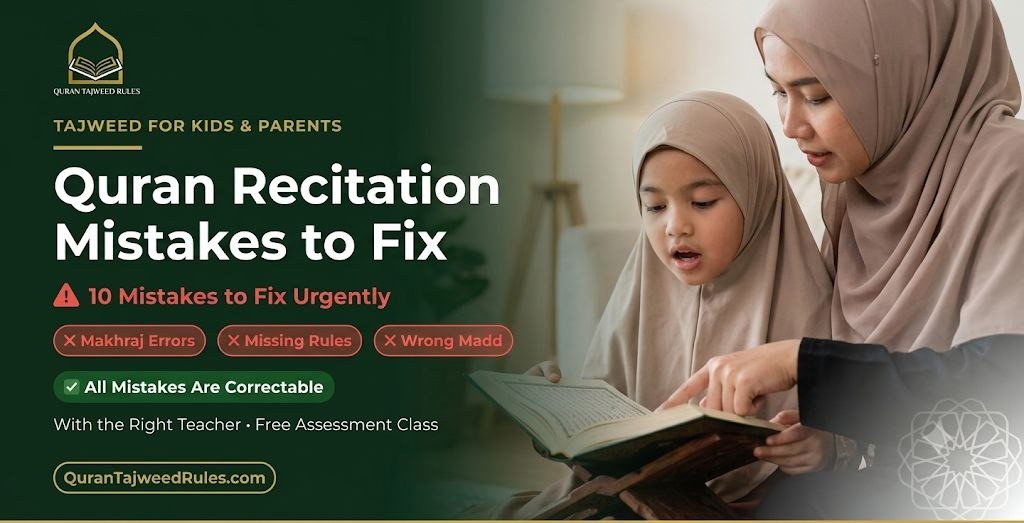
Every Muslim parent wants their child to recite the Quran beautifully. But most parents do not know that certain Quran recitation mistakes — errors that children make innocently and consistently — solidify into permanent habits if left uncorrected. The longer these mistakes persist, the harder they become to undo.
The encouraging news is this: every mistake in this guide is completely correctable with the right approach. Children who have been making these errors for years can correct them within weeks of working with a certified Tajweed teacher. But the earlier these mistakes are identified and corrected, the easier and faster the correction process is.
This guide identifies the 10 most common Quran recitation mistakes children make — with the wrong sound, the correct sound, a real Quranic example, and a practical fix for each one. By the end, you will know exactly what to listen for, what to do about it, and how to get your child the certified guidance that makes permanent correction possible.
|
What You Will Learn in This Guide Why Quran recitation mistakes must be corrected early • The 10 most common mistakes children make • Wrong vs correct for each mistake with Quranic examples • Practical fixes parents can apply at home • When to involve a certified teacher • The complete pathway from correction to confident recitation |
Why Quran Recitation Mistakes Must Be Corrected Before They Solidify
The most important fact about Quran recitation mistakes in children is this: the brain normalizes the sounds it produces. A child who mispronounces ع (Ain) as a simple vowel does not hear the error — because their brain processes the sound they produce as correct. The longer this incorrect sound is reinforced through repetition, the more deeply it is mapped as “normal.”
This normalization process is why children who have been reciting incorrectly for 5 years are harder to correct than children who have been reciting incorrectly for 5 months. The neural pathways for the incorrect sound are more deeply established. Correction is still completely possible — but it requires more time and more conscious effort.
Every prayer your child performs with a corrected recitation is an act of worship that is more precise and more beautiful. Every Quran recitation mistake that persists through childhood becomes a habit that shapes every prayer they perform for the rest of their life. The decision to correct these mistakes now is one of the most valuable gifts a parent can give.
10 Common Quran Recitation Mistakes Children Make — and How to Fix Them
Mistake 1: Mispronouncing ع (Ain) as a Simple Vowel
|
Wrong: Child says أنْعَمْتَ as “an-amta” — the Ain disappears into the vowel Correct: Ain must come from the mid-throat with a deliberate constriction — “an-ʿamta” with a clear pharyngeal sound before the vowel Example: أنْعَمْتَ عَلَيْهِمْ in Al-Fatiha — appears in every single prayer |
 Mistake 1: Treating ع (Ain) as a vowel sound
The ع (Ain) is perhaps the most commonly mispronounced letter by non-Arabic speaking children. It has no equivalent in English, French, Urdu, or most non-Arabic languages, which means children’s brains have no existing template for it and default to the nearest familiar sound — a simple vowel.
|
Step 1: Ask your child to say ‘ah’ normally. Step 2: Then ask them to gently squeeze the middle of their throat (not the top or bottom — the middle) while making the same sound. Step 3: That subtle constriction is the beginning of Ain. Practice daily for 1 week. Step 4: Apply in context: أنْعَمْتَ in Al-Fatiha — until the mid-throat constriction is automatic. |
 How to Fix Ain Mispronunciation
Mistake 2: Shortening or Skipping Madd (Elongation)
|
Wrong: Child recites الرَحْمَٰنِ as “al-rahman” (no elongation on the alif) Correct: Every Madd letter must be held for exactly 2 counts (Natural Madd). “al-raHMAAn” with clear 2-count elongation on the alif Example: Al-Rahman, Al-Raheem in Al-Fatiha — Madd appears in virtually every verse |
Shortened Madd is one of the most audible Quran recitation mistakes in children’s recitation. It makes the recitation sound rushed, flat, and stripped of the rhythmic beauty that correct Madd produces. Yet it is also one of the easiest mistakes to fix because Madd letters are visually identifiable in a Tajweed Mushaf.
|
Step 1: Get a Tajweed Mushaf. Show your child the colour-coded Madd letters. Step 2: Practice counting: “One-two” for every Madd. Tap the table twice while holding the sound. Step 3: Recite Al-Fatiha slowly, tapping twice on every Madd letter. Step 4: Record your child and listen back together — do you hear 2 full counts on every Madd? |
|
The complete guide to Madd rules with Quranic examples — including how to identify and correct Madd errors at every level. |
 Tajweed Rules with Examples: Madd, Qalqalah, Ghunnah
Mistake 3: Missing Ghunnah on Shaddah Noon and Meem
|
Wrong: Child says إنَّا (Inna) without any nasal vibration — purely from the mouth Correct: Every Noon or Meem with Shaddah requires 2-count Ghunnah through the nose. The nasal passage must vibrate. Example: إنَّا أعْطَيْنَاكَ الْكَوْثَرَ (Surah Al-Kawthar) — the Noon with Shaddah in Inna |
Missing Ghunnah is a Quran recitation mistake that completely changes the sonic character of the recitation. Ghunnah is responsible for much of the nasal warmth and resonance that characterizes beautiful Quranic recitation. Without it, the recitation sounds dry and flat.
|
Step 1: Place two fingers on either side of your child’s nose. Step 2: Ask them to say إنَّا (Inna) slowly. Step 3: Do they feel vibration in the nose? If no — Ghunnah is missing. Step 4: Practice humming through the nose (like a bee sound) for 2 counts before the following vowel. Step 5: Apply in Surah Al-Kawthar daily until the nasal vibration is automatic. |
Mistake 4: Missing Qalqalah (The Echo Sound)
|
Wrong: Child says قُلْ (Qul) with a hard stop — no echo after the Lam Correct: The 5 Qalqalah letters (قطبجد) require a brief echo/bounce sound when they carry Sukoon. The letter is stopped then lightly released with a vibration. Example: Surah Al-Ikhlas: قُلْ (Qul), الصَمَدْ (as-Samad), أَحَدٌ (Ahadun) — all require Qalqalah |
Missing Qalqalah is one of the most recognizable Quran recitation mistakes because Qalqalah letters appear in Surah Al-Ikhlas — one of the most recited Surahs in the Quran. A child who recites Al-Ikhlas without Qalqalah is missing a rule that appears 4-5 times in just 4 verses.
|
Step 1: Explain Qalqalah as “the bouncing ball sound”. Step 2: Have your child bounce their hand on the table each time a Qalqalah letter appears at a stop point. Step 3: Recite Surah Al-Ikhlas together, bouncing on every Dal. Step 4: The physical movement anchors the sound. After 3-5 sessions, remove the hand bounce — the echo should now be automatic. |
Mistake 5: Mispronouncing ض (Dad) as a D Sound
|
Wrong: Child says الضَّآلِّينَ as if the Dad were a regular D Correct: Dad must come from the side of the tongue pressing against the upper back molars — a wide, heavy sound that is completely different from D. Example: الضَّآلِّينَ (ad-daaalleen) in Al-Fatiha — the most common Dad error in daily prayer |
The ض (Dad) is so unique that Arabic is sometimes called “Lughat Al-Dad” (the language of Dad). It is produced from the side of the tongue pressing against the upper back teeth — not the tip, not the front. This Quran recitation mistake appears in Al-Fatiha in the word الضَّآلِّينَ, which Muslims recite in every Salah.
|
Step 1: Ask your child to say ‘d’ normally — notice the tongue tip touches behind the upper teeth. Step 2: Now ask them to move the tongue contact point back to the upper side molars. Step 3: The tongue sides press against the upper back teeth — this produces a heavier, wider sound. Step 4: Practice ضَ ضَ ضَ slowly until the side-tongue contact is consistent. Step 5: This mistake benefits enormously from a certified teacher’s real-time correction. |
Mistake 6: Applying Idgham Inside a Single Word
|
Wrong: Child applies Idgham to دُنْيَا (dunya), merging the Noon into the Ya Correct: Idgham only applies when Noon Sakinah is at the END of a word and the NEXT word begins with a Yarmalu letter. Within one word, the Noon is always pronounced clearly. Example: دُنْيَا (dunya), بُنْيَان (bunyaan), صِنْوَان (sinwaan) — the 4 famous same-word exceptions |
This Quran recitation mistake is very common in children who have learned Noon Sakinah rules without the critical same-word exception. They correctly learn that Noon before Ya triggers Idgham — and then apply it everywhere, including inside single words where it should not apply.
|
Step 1: Teach the rule clearly: Idgham ONLY crosses from one word to the next. Step 2: Memorize the 4 exception words: دُنْيَا, بُنْيَان, صِنْوَان, قِنْوَان. Step 3: Every time these words appear, the Noon is clear and distinct. Step 4: Create a simple visual card with these 4 words and place it near your child’s study area. |
|
The complete guide to all 4 Noon Sakinah rules — including the critical same-word exception that prevents this very common recitation mistake. |
Mistake 7: Mispronouncing ق (Qaf) as ك (Kaf)
|
Wrong: Child says قُلْ (Qul) with a Kaf-like sound — the sound comes from the middle-back of the mouth Correct: Qaf must come from the very back of the tongue touching the uvular area — deeper than Kaf. It is a distinctly different, deeper sound. Example: قُلْ (Qul) in Surah Al-Ikhlas — the very first word of one of the most recited Surahs |
Confusing ق (Qaf) and ك (Kaf) is a critical Quran recitation mistake because it changes the word. The word قلب (qalb) means “heart” — but if Qaf is replaced with Kaf, it becomes كلب (kalb), meaning “dog.” This is the kind of error that alters meaning and must be corrected urgently.
|
Step 1: Have your child say Kaf (ك) normally and notice where the tongue touches. Step 2: Now push the tongue contact point as far back as possible — to the very back of the mouth, almost at the throat. Step 3: That back-of-mouth position is where Qaf lives. Step 4: Practice كَ قَ كَ قَ alternately until the difference is clearly audible. Step 5: Apply in context: قُلْ in Al-Ikhlas — confirm the Qaf comes from the right position. |
Mistake 8: Rushing Through Waqf and Stopping at Wrong Places
|
Wrong: Child stops after أنْعَمْتَ عَلَيْهِمْ and begins غَيْرِ separately, breaking the meaning Correct: Follow the Waqf signs in the Tajweed Mushaf. The لا sign means do NOT stop here. The م sign means you MUST stop. Example: Al-Fatiha: stopping between أنْعَمْتَ عَلَيْهِمْ and غَيْرِ الْمَغْضوبِ changes the meaning of the phrase |
Incorrect Waqf is a Quran recitation mistake that can change or confuse the meaning of verses. Al-Fatiha alone has specific Waqf points that must be respected. Children who have not been taught to use Waqf signs often pause at natural breath points, which may be grammatically or theologically incorrect positions.
|
Step 1: Get a Tajweed Mushaf and teach your child the 5 main Waqf symbols. Step 2: م (Must stop) | ط (Better to stop) | ج (Optional) | ز (Better to continue) | لا (Do NOT stop) Step 3: Practice Al-Fatiha slowly, identifying every Waqf sign before reciting. Step 4: Never take a breath at a لا sign — even if it feels like a natural pause point. |
Mistake 9: Producing Iqlab Incorrectly or Missing It Entirely
|
Wrong: Child says مِنْ بَعْدِ as “min-ba‘d” — the Noon is fully pronounced before Baa Correct: Iqlab converts the Noon to a nasal Meem-like sound with 2-count Ghunnah: “mim-ba‘d.” The lips come lightly together, nasal tone held, then Baa released. Example: مِنْ بَعْدِ — “from after” — appears throughout the Quran |
Iqlab is the least common of the 4 Noon Sakinah rules — but it is also the most distinctive-sounding, which means getting it wrong is immediately audible. Many children either completely skip Iqlab (treating it as Izhar) or convert the Noon fully into a Meem (overshooting the rule). Both are Quran recitation mistakes that a certified teacher can correct within 1-2 focused sessions.
Mistake 10: Reciting Too Fast Without Applying Any Rules
|
Wrong: Child recites Surah Al-Fatiha in 8 seconds, all rules collapsed into a flat, rushed stream of sound Correct: Recitation must be at a pace where every rule can be consciously applied. Tarteel (measured recitation) is commanded by Allah in Surah Al-Muzzammil: وَرَتِّلِ الْقُرْآنَ تَرْتِيلاً Example: Any Surah — Quran recitation speed affects every single rule simultaneously |
Speed is perhaps the most damaging of all Quran recitation mistakes because it does not just violate one rule — it makes applying all rules impossible simultaneously. A child who recites Al-Fatiha in 8 seconds cannot be counting Madd, producing Qalqalah, holding Ghunnah, and applying Noon Sakinah rules — it is physically and cognitively impossible at that speed.
The Quran commands measured recitation: وَرَتِّلِ الْقُرْآنَ تَرْتِيلاً (Surah Al-Muzzammil 73:4). Tarteel means giving every letter its right — which requires sufficient time. Speed is not a virtue in Quran recitation. Precision is.
|
Step 1: Time your child reciting Al-Fatiha. Now ask them to recite it in exactly double the time. Step 2: At the slower pace, can they apply Madd, Qalqalah, and Ghunnah? If yes — this is the correct speed. Step 3: Listen to Sheikh Al-Husary’s Muallim recording together — this sets the correct pace standard. Step 4: Practice one Surah per week at the correct speed until that pace becomes the child’s natural default. |
The Most Important Fix: Working with a Certified Teacher
All 10 Quran recitation mistakes in this guide are correctable at home with consistent practice. But there is a ceiling to what home correction can achieve. The reason is simple: you cannot hear your child’s errors with the same precision that a trained teacher can.
A certified Tajweed teacher identifies Quran recitation mistakes in the first lesson that parents have never noticed — not because the parents are inattentive, but because identifying subtle phonetic errors requires trained ears that have been specifically educated to detect them. The teacher then provides targeted, immediate correction that home practice cannot replicate.
The ideal model for correcting children’s Quran recitation mistakes is: certified teacher lessons 2-3 times per week, where specific errors are identified and corrected, plus parent-supported home practice between lessons that reinforces what the teacher corrected.
|
What Happens in a Correction Lesson at Quran Tajweed Rules Academy Lesson 1: Teacher listens to child recite Al-Fatiha. Identifies 3-5 specific errors (typically Ain mispronunciation, Madd shortening, and missing Ghunnah). Lesson 2: Focused correction of identified errors with targeted exercises. Lesson 3: Child applies corrections in full Surah recitation. Teacher verifies improvement. By Lesson 5: Most common errors corrected and beginning to feel natural. |
Related Guides: Everything Parents Need to Prevent and Fix Quran Recitation Mistakes
|
The foundational guide to understanding what Tajweed is and why it matters — essential context for every parent concerned about their child’s recitation mistakes. |
|
The foundation that prevents most Quran recitation mistakes — correct letter articulation from the very first lesson. Essential reading for parents. |
|
All 7 rules your child needs to know — with real Quranic examples. Understanding these rules helps parents identify and discuss their child’s recitation mistakes accurately. Read: qurantajweedrules.com/essential-tajweed-rules-for-beginners |
|
How to build correct habits from the start — preventing recitation mistakes before they form through games, activities, and child-appropriate methods. |
|
The complete parent’s guide to supporting correct recitation at home — including the daily practice routine that prevents and corrects common mistakes. |
The Complete Learning Pathway to Correct Every Quran Recitation Mistake
The fastest, most reliable way to correct your child’s Quran recitation mistakes is through a structured course with a certified teacher. At Quran Tajweed Rules Academy, the children’s learning pathway is designed to identify and correct every recitation mistake from the very first lesson:
|
STEP 1 — Tajweed Rules for Kids Course Identifies and corrects all common Quran recitation mistakes from lesson one. What your child gets: ✓ First lesson: teacher listens to child and identifies all current recitation mistakes ✓ Structured correction plan targeting the child’s specific errors ✓ Al-Azhar certified teachers with children’s specialization ✓ 20-30 minute focused lessons — optimal for children’s correction sessions ✓ Progress reports for parents after every lesson ✓ Free trial class — first mistake identification at no cost |
 CORRECTION STARTS HERE
 qurantajweedrules.com/tajweed-rules-for-kids
|
STEP 2 — Quran Tajweed Course for Beginners For older children (13+) ready for adult-style structured Tajweed. What your child gets: ✓ Complete Makharij and all 7 rules in structured 20-hour curriculum ✓ Systematic correction of all recitation mistakes ✓ Al-Azhar certified teachers ✓ Free trial class available |
 FOUNDATION
|
STEP 3 — Advanced Quran Tajweed Rules Course For teenagers who have corrected all basic mistakes and are ready for advanced rules. What your child gets: ✓ Advanced Madd, Sifaat Al-Huruf, Tafkhim and Tarqiq ✓ Full Surah recitation with no remaining mistakes ✓ Ijazah preparation pathway |
 MASTERY
|
STEP 4 — Quran Ijazah in Hafs Online Course Formal certification for recitation that is completely free of mistakes. What your child gets: ✓ Complete Quran recitation verified by Ijazah-holding Sheikh ✓ Internationally recognized Ijazah certificate ✓ Entry into the chain from the Prophet صلى الله عليه وسلم |
 CERTIFICATION
|
STEP 5 — 10 Qiraat Course Optional. For dedicated young scholars of the Quranic tradition. What your child gets: ✓ All 10 authentic Qiraat ✓ Senior Al-Azhar scholars ✓ Formal Ijazah in multiple Qiraat |
 EXCELLENCE
Frequently Asked Questions: Quran Recitation Mistakes
How do I know if my child is making Quran recitation mistakes?
The most reliable way to identify your child’s Quran recitation mistakes is to have a certified teacher listen to their recitation. Teachers trained in Tajweed can identify errors that parents cannot hear because they are trained to detect subtle phonetic differences. For a general assessment, book a free trial class at Quran Tajweed Rules Academy — the teacher will identify your child’s specific errors in the first session.
Can Quran recitation mistakes be corrected after years of incorrect practice?
Yes. Every Quran recitation mistake in this guide is correctable regardless of how long it has been practiced. Children’s recitation habits are less deeply entrenched than adults’, which means correction is often faster than parents expect. A certified teacher who provides targeted, consistent correction can resolve most common mistakes within 4-8 weeks of focused sessions.
Is mispronouncing letters in Salah a problem?
Yes. Quran recitation mistakes that change the meaning of words — known as Al-Lahn Al-Jali (clear errors) — are considered problematic by Islamic scholars and should be corrected urgently. Examples include pronouncing ع as a simple vowel or ق as ك. Scholars recommend that every Muslim learn enough Tajweed to avoid meaning-changing errors in their daily Salah recitation.
At what age should I start correcting my child’s recitation mistakes?
Correcting Quran recitation mistakes is most effective when started early — ideally before age 10, when phonetic plasticity is at its peak and incorrect habits have not yet deeply solidified. However, correction is beneficial and achievable at any age. A certified teacher can work effectively with children of 5, teenagers of 15, and adults of 40. The earlier correction begins, the faster and more naturally it happens.
Every Mistake Is Correctable — Start Today
The 10 Quran recitation mistakes in this guide are not causes for alarm. They are normal, predictable errors that appear in children who have not yet had the benefit of certified Tajweed instruction. Every mistake is correctable. Every child can learn to recite with the precision and beauty that the words of Allah deserve.
The most powerful action you can take as a parent today is to have your child’s recitation assessed by a certified teacher. The first lesson at Quran Tajweed Rules Academy is free — and the teacher will identify your child’s specific errors, explain how each one will be corrected, and begin the correction process in that very first session.
Your child’s recitation can be transformed. Their journey to correct, beautiful Quran recitation begins with one click.
|
Book Your Child’s Free Recitation Assessment Have your child’s Quran recitation assessed by a certified Al-Azhar teacher at Quran Tajweed Rules Academy. Every error identified. Every correction explained. First class completely free. Visit: qurantajweedrules.com/freetrial |