
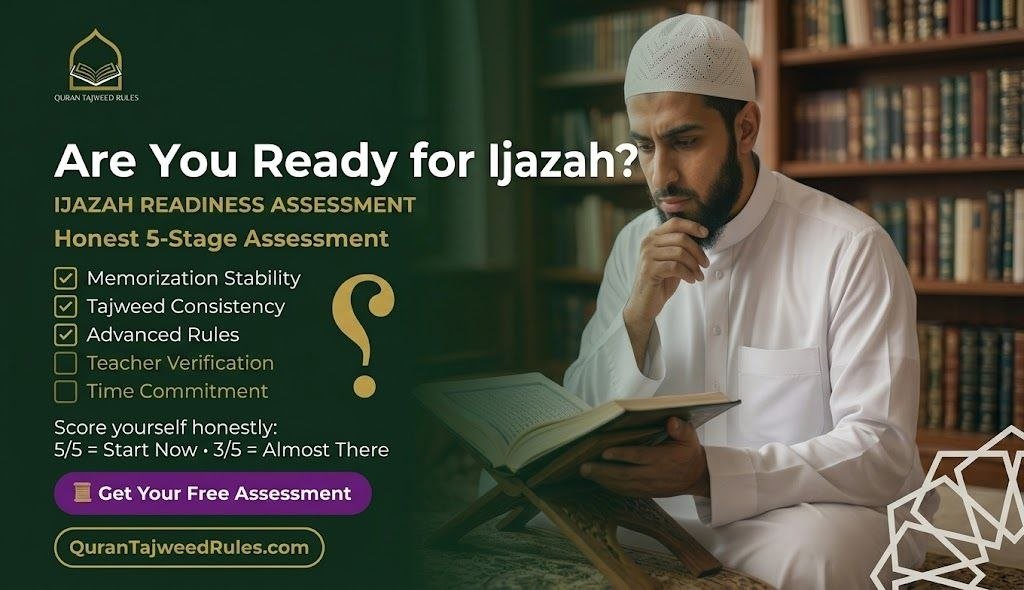
One of the most honest questions a serious Quran student asks is: am I ready for an Ijazah course? Not out of self-doubt, but out of genuine respect for the process — a recognition that beginning Ijazah preparation before you are truly ready for an Ijazah course wastes time, discourages progress, and may produce more frustration than achievement.
The honest answer requires looking at 5 specific dimensions of readiness — not just whether you can recite beautifully in familiar Surahs, but whether your Tajweed is consistent across the entire Quran, whether your memorization is stable enough for examination, and whether your Tajweed has been verified by a certified teacher at the level the examination requires.
This guide gives you a clear, honest assessment framework to determine whether you are ready for an Ijazah course now, close to ready, or still building the foundation. It includes 5 readiness checks with specific self-tests, a scoring framework, the most common gaps students discover, and the complete learning pathway at Quran Tajweed Rules Academy.
|
What You Will Learn in This Guide The 5 dimensions of Ijazah readiness • Specific self-tests for each readiness dimension • A scoring framework to assess your current level honestly • The most common gaps between ‘good reciter’ and ‘ready for Ijazah’ • The Hifz vs Nazr pathway decision • What to do if you are not yet ready • The complete pathway from beginner to Ijazah |
Why Honest Assessment Matters Before Starting an Ijazah Course
The question of whether you are ready for an Ijazah course matters because Ijazah preparation is not like a standard Tajweed course where a student learns progressively and mistakes are part of the learning process. Ijazah examination is a verification — the Sheikh listens to your recitation to confirm it is already at the required standard, not to teach it to you for the first time.
Students who begin Ijazah course preparation before they are ready encounter a specific, discouraging pattern: the Sheikh identifies numerous Tajweed errors across multiple Juz, the student must stop and correct them, the examination timeline extends far beyond what was expected, and the process feels like struggle rather than verification. This experience is not inevitable — it is the result of beginning before the foundation is truly solid.
A student who honestly assesses their readiness, addresses their gaps first, and then begins the Ijazah course experiences the process very differently: corrections are minor, the recitation flows, the Sheikh’s feedback is refining rather than foundational, and the timeline is realistic.
The 5 Readiness Checks: Are You Ready for an Ijazah Course?
Work through all 5 of these readiness checks honestly. Each one tests a specific dimension of Ijazah course readiness. At the end, use the scoring framework to interpret your results.
Readiness Check 1: Quran Memorization Stability
The most fundamental question of Ijazah course readiness is whether you have stable Quran memorization. The traditional Ijazah pathway (Hifz pathway) requires complete memorization of all 30 Juz. The alternative Nazr pathway (reading from Mushaf) is available but still requires being able to locate and begin reciting from any point in the Quran immediately when asked.
|
Readiness Check 1: Quran Memorization Stability Self-test: Can your Sheikh or a trusted examiner open the Mushaf to any page at random and ask you to recite the next 10 verses from memory (Hifz pathway) or begin reading fluently and correctly (Nazr pathway)?
|
 Ready: You can recite from any point in the Quran with minimal hesitation. Your memorization holds under pressure, not just in comfortable practice sessions.
 Not Yet: Your memorization has gaps, weak spots in certain Juz, or requires frequent prompting. More consolidation is needed before beginning Ijazah examination.
Students on the Nazr (reading) pathway to Ijazah need a different form of fluency: they must be able to read any text in the Quran at an appropriate pace with accurate voweling, without slow hesitation or letter recognition errors. If your reading pace is significantly slower than your Sheikh’s recitation in examination sessions, this needs to be addressed before Ijazah readiness is achieved.
Readiness Check 2: Essential Tajweed Rule Consistency
The second dimension of Ijazah course readiness is whether your 7 essential Tajweed rules are applied consistently across the entire Quran — not just in the Surahs you know best. The Ijazah examination tests this consistency precisely: the Sheikh will ask you to recite from Surah Al-Baqarah (Juz 1), then from Surah Al-Kahf (Juz 15), then from Surah Qaaf (Juz 26) — assessing whether your Tajweed quality is uniform across the Quran or only strong in the sections you have practiced most.
|
Readiness Check 2: Essential Tajweed Consistency Self-test: Record yourself reciting 5 random pages from 5 different Juz — Juz 1, 6, 15, 22, and 28. Listen back. Is your Noon Sakinah application, Madd length, Ghunnah, and Qalqalah consistent across all 5? Or does quality drop significantly in less-practiced sections?
|
|
The 7 rules that must be consistent across your entire Quran recitation before you are ready for an Ijazah course. Read: qurantajweedrules.com/essential-tajweed-rules-for-beginners |
 7 Essential Tajweed Rules for Beginners
|
The 4 Noon Sakinah rules verified in every Juz of the Ijazah examination — ensure mastery before beginning. |
Readiness Check 3: Advanced Tajweed Rules Application
Being ready for an Ijazah course requires more than the 7 essential Tajweed rules. Ijazah examination operates at the level of advanced Tajweed rules: all Madd types applied correctly (not just Natural Madd), Sifaat Al-Huruf reflected in letter pronunciation, Ra rules applied correctly in all contexts, Lam Al-Jalalah correctly heavy or light throughout, advanced Waqf categories observed, and Hamzah Al-Wasl applied correctly in connected recitation.
|
Readiness Check 3: Advanced Tajweed Rules Application Self-test: Recite Surah Al-Baqarah (pages 1-5) with a certified teacher and ask for feedback specifically on: Madd Arid application at verse endings, Ra heaviness and lightness in every occurrence, Lam Al-Jalalah in every instance of Allah, and Hamzah Al-Wasl in connected phrases. How many corrections does the teacher provide across 5 pages?
|
|
The complete advanced Tajweed curriculum — every category that must be mastered before you are ready for an Ijazah course. |
Readiness Check 4: Teacher Verification of Your Recitation
Being ready for an Ijazah course is not something you can fully determine through self-assessment alone. Your brain normalizes the sounds you produce, making your own recitation sound more correct to yourself than it may be to a trained ear. The most reliable readiness check is having an Al-Azhar Certified Teacher listen to your recitation of an unfamiliar passage and provide an honest assessment of your Tajweed standard.
|
Readiness Check 4: Teacher Verification Self-test: Ask an Al-Azhar Certified Teacher to listen to you recite 3 pages from a Juz you have not practiced recently and give you an honest assessment: “Based on what you heard, am I ready to begin Ijazah course preparation, or do I have gaps to address first?”
|
|
Why the teacher’s assessment in Readiness Check 4 must come from an Al-Azhar Certified Teacher — not just any Quran teacher. |
Readiness Check 5: Emotional and Time Commitment Readiness
The final dimension of Ijazah course readiness is often the least discussed: the emotional and time commitment required. The Ijazah process involves sustained sessions of being listened to and corrected by a Sheikh — sometimes on the same passage multiple times. It requires patience with the correction process, resilience when errors are identified in passages you thought were solid, and consistent time investment over what may be many months.
|
Readiness Check 5: Emotional and Time Readiness Self-test: Can you commit to 2-3 Ijazah preparation sessions per week for the next 6-18 months? Can you receive correction on your recitation without becoming discouraged? Are you pursuing Ijazah for a genuine reason that will sustain your motivation through the demanding middle stages of the process?
|
Your Ijazah Course Readiness Score: What It Means
Now that you have completed all 5 readiness checks, use this framework to interpret your results and determine your Ijazah course readiness:
|
Your Score |
Readiness Level |
Recommended Action |
|
5 out of 5 |
Fully Ready |
Begin Ijazah course preparation immediately. Book your assessment session with a certified Sheikh at Quran Tajweed Rules Academy. |
|
4 out of 5 |
Nearly Ready |
Identify and address the one gap. With 2-4 months of targeted study, you will be fully ready. |
|
3 out of 5 |
Strong Foundation |
You have a solid base but need 6-12 months of focused work. Begin the Advanced Tajweed Rules course immediately. |
|
2 out of 5 |
Building Toward |
Great progress so far. 12-18 months of structured Advanced study will bring you to readiness. Start now. |
|
1 out of 5 |
Foundational Work |
Focus on the Beginners or Advanced course. Ijazah is a real, achievable goal — build the foundation solidly first. |
The Most Common Gaps Between ‘Good Reciter’ and ‘Ready for Ijazah Course’
Most students who score 3-4 out of 5 on the readiness checks have a small number of specific gaps separating them from being ready for an Ijazah course. Here are the most common:
Gap 1: Madd Consistency Across the Full Quran
The most common single gap identified in Ijazah readiness assessments is inconsistent Madd lengths — not in the familiar short Surahs, but across the Quran. Students whose Madd is consistent in Juz Amma may not have developed the same automatic consistency through the longer, less-practiced Surahs of Juz 2-29. The fix: systematic recitation practice across all 30 Juz with specific attention to Madd type identification and counting.
Gap 2: Advanced Ra Rules
The second most common gap in students nearly ready for an Ijazah course is Ra pronunciation: producing light Ra in all Kasra contexts and heavy Ra in all other contexts, automatically and consistently throughout the Quran. Students whose beginner Tajweed study did not include detailed Ra rules often have strong rules for familiar Surahs but inconsistency in less-familiar passages.
Gap 3: Waqf and Ibtida at Full Quran Scale
While students may know the principle of Waqf signs, being ready for an Ijazah course requires applying Waqf rules across the entire Quran — knowing where to pause appropriately when breath runs out in the middle of a long verse, and knowing where to resume after a pause to ensure the meaning is grammatically and theologically intact. This requires specific practice beyond Juz Amma.
Gap 4: Recitation Under Examination Pressure
Some students are fully ready for an Ijazah course in their solo practice sessions but have not yet experienced reciting under the examination conditions of a Sheikh listening and evaluating in real time. If this is your gap, the solution is not more practice alone — it is more practice in front of your certified teacher, building comfort with evaluated recitation before the formal examination begins.
The Hifz vs Nazr Decision: Which Ijazah Pathway Are You Ready For?
Being ready for an Ijazah course also involves clarity about which of the two pathways you will pursue:
The Hifz (Memorization) Pathway
The Hifz pathway to Ijazah course completion requires complete, stable memorization of the entire Quran. You are ready for this pathway when: your memorization of all 30 Juz is stable under pressure; you can be asked to recite from any point without significant hesitation; your Tajweed across all memorized sections meets the advanced standard; and you have the time commitment for a process that may extend 12-18 months of regular sessions.
The Nazr (Reading) Pathway
The Nazr pathway to Ijazah course completion allows recitation from the Mushaf, with the same Tajweed standard required. You are ready for this pathway when: you can read any page of the Quran fluently and with correct voweling; your Tajweed rules are applied at the advanced standard consistently; and you can recite at an appropriate pace while reading — not halting or sounding out letters.
|
Which Pathway Is Right for You? If you have Hifz: The Hifz pathway connects you more deeply to the tradition and produces the most complete Ijazah experience. Complete verification of all 30 Juz from memory is the pinnacle of this process. If you do not have Hifz but have strong advanced Tajweed: The Nazr pathway is a fully legitimate and authenticated alternative that allows you to earn a genuine, recognized Ijazah without requiring full memorization. Both pathways lead to the same Ijazah certificate and Isnad. |
What to Do If You Are Not Yet Ready for an Ijazah Course
If your honest self-assessment reveals you are not yet ready for an Ijazah course, this is positive information — not discouraging news. It means you have a clear, specific pathway forward:
If You Need to Complete Beginner Tajweed
Students who have not yet formally studied the 7 essential Tajweed rules with a certified teacher should begin with the Quran Tajweed Course for Beginners at Quran Tajweed Rules Academy. This course builds the Makharij foundation and all 7 essential rules in a structured, one-on-one format with Al-Azhar Certified Teachers. The estimated timeline to complete: 3-6 months of consistent study.
|
Understand the complete map of Tajweed before beginning formal study — essential context for every student at every stage. |
If You Need to Complete Advanced Tajweed
Students who have solid beginner Tajweed but have not yet covered advanced rules should begin the Advanced Quran Tajweed Rules Course immediately. This is the most direct pathway to becoming ready for an Ijazah course for the majority of intermediate students — covering Sifaat Al-Huruf, complete Madd system, Ra rules, advanced Waqf, and Hamzah rules that are all verified in Ijazah examination.
|
The complete advanced curriculum — the most direct path to closing the gap between intermediate Tajweed and Ijazah-standard recitation. |
If You Need to Strengthen Memorization
Students who have the Tajweed standard for Ijazah but whose Hifz is not yet stable enough for examination can pursue the Nazr pathway while continuing their memorization simultaneously. There is no requirement to complete Hifz before beginning Ijazah course preparation through the Nazr pathway.
The Complete Pathway from Beginner to Ready for Ijazah Course
For every student at every stage, here is the complete pathway from wherever you are today to being ready for an Ijazah course at Quran Tajweed Rules Academy:
|
STEP 1 — Quran Tajweed Course for Beginners Build the Makharij foundation and all 7 essential rules — required before advanced study. What you get: ✓ Complete Makharij Al-Huruf from lesson one ✓ All 7 essential rules with Quranic examples ✓ Al-Azhar Certified Teachers ✓ 20 hours one-on-one lessons ✓ Free trial class available |
 FOUNDATION
 qurantajweedrules.com/quran-tajweed-course-for-beginners
|
STEP 2 — Advanced Quran Tajweed Rules Course Master every advanced rule required for Ijazah course readiness. What you get: ✓ Sifaat Al-Huruf, complete Madd system, Ra and Lam Al-Jalalah rules ✓ Advanced Waqf categories and Hamzah Al-Wasl ✓ Full Surah recitation reviews with senior Al-Azhar scholars ✓ Readiness assessment for Ijazah preparation ✓ 24 hours advanced instruction |
 ADVANCED
|
STEP 3 — Online Ijazah in Hafs Course You are ready for an Ijazah course. Begin the formal certification process. What you get: ✓ Initial evaluation to confirm and finalize Ijazah readiness ✓ Advanced Tajweed refinement to Ijazah examination standard ✓ Complete Quran recitation (Khatmah) with Sheikh ✓ Formal examination and certification ✓ Internationally recognized Ijazah certificate and Isnad document ✓ Authorization to teach and grant Ijazah to others |
 IJAZAH
|
STEP 4 — 10 Qiraat Course Optional. Extend your Ijazah to all 10 authentic recitation styles. What you get: ✓ All 10 Qiraat with unique rules and verified chains ✓ Senior Al-Azhar scholars with Ijazat in multiple Qiraat ✓ Formal Ijazah in multiple Qiraat upon completion |
 BEYOND
Related Guides: Continue Building Toward Ijazah Course Readiness
|
Understand what you are working toward — the complete definition, history, and significance of the Ijazah you are preparing for. |
|
Once you are ready for an Ijazah course, this is the complete process — from initial evaluation to receiving your certificate. |
|
The Makharij foundation verified in the Ijazah examination — ensure precision across all 29 letters before beginning. |
|
The 3 most audible rules verified in the Ijazah examination — ensure consistent application across the full Quran. |
|
Understand the broader tradition of Quranic recitation that your Ijazah in Hafs connects you to. |
Frequently Asked Questions: Ready for Ijazah Course
Can I start an Ijazah course while still memorizing the Quran?
Yes, through the Nazr (reading) pathway. Students who are still working on their Hifz can begin Ijazah course preparation through the reading pathway — reciting from the Mushaf at the required Tajweed standard — while simultaneously continuing their memorization. Many students complete the Nazr Ijazah and then pursue a Hifz Ijazah once their memorization is complete.
How do I know if my Tajweed is at Ijazah standard?
The most reliable way to assess whether you are ready for an Ijazah course at the Tajweed level is to have an Al-Azhar Certified Teacher — preferably one who has experience with Ijazah examination — listen to your recitation of unfamiliar passages and give you an honest, specific assessment. Self-assessment through recording is helpful but insufficient because the brain normalizes its own errors.
What happens at the very start of an Ijazah course?
At Quran Tajweed Rules Academy, the Ijazah course begins with a comprehensive evaluation session: the Sheikh listens to your recitation across multiple Juz, identifies your current Tajweed standard, confirms your readiness level, and designs a preparation plan targeting your specific gaps before the formal examination sessions begin. This initial evaluation is included in the Ijazah course and ensures no time is wasted on errors that could have been addressed before examination begins.
Is it possible to fail an Ijazah examination?
The Ijazah process is structured to prevent outright failure: if Tajweed errors are found during examination sessions, the Sheikh pauses, corrects, and has the student repeat the passage until it is correct before proceeding. The examination does not end with “pass” or “fail” in a binary sense — it continues until the standard is met. What differs is the timeline: students who are truly ready for an Ijazah course complete the process in 3-6 months; those who begin before they are ready may take significantly longer because significant portions of the Quran require repeated correction sessions.
Take Your Next Step Toward Ijazah Course Readiness
Now you have an honest, specific answer to the question: am I ready for an Ijazah course? Whether your score is 5 out of 5 (begin immediately) or 2 out of 5 (build the foundation now), your path forward is clear.
At Quran Tajweed Rules Academy, every student at every stage of this journey has a course, a certified teacher, and a structured pathway designed specifically for their level. Whether you are beginning from the fundamentals, completing advanced Tajweed study, or ready to begin Ijazah preparation today, your next step starts with a free trial class.
|
Book Your Free Trial Class — Assess Your Ijazah Readiness Today Begin your readiness assessment with an Al-Azhar Certified Teacher at Quran Tajweed Rules Academy. Whether you are ready for an Ijazah course now or still building toward it, your first lesson is completely free. Visit: qurantajweedrules.com/freetrial Ijazah Course: qurantajweedrules.com/online-ijaza-in-hafs |
One Response