
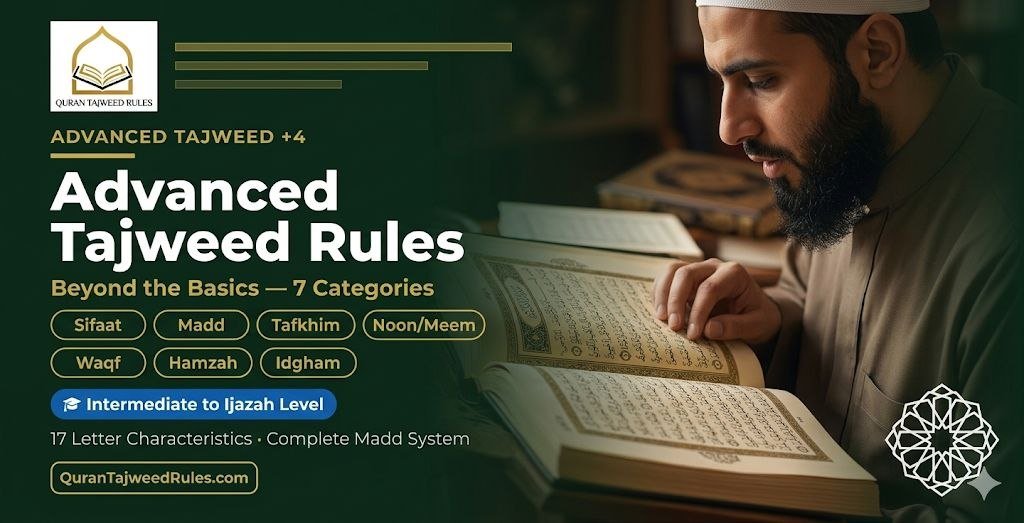
You have mastered the 7 essential Tajweed rules. You apply Noon Sakinah confidently. Your Madd lengths are consistent. Your Ghunnah is nasal. But something is still missing from your recitation — a precision, a fluency, a naturalness that you hear in the recitation of truly advanced students and certified scholars. That gap is filled by advanced Tajweed rules.
The advanced Tajweed rules go beyond the essential beginner curriculum to address the complete science of Arabic letter characteristics, the full system of Madd types, the nuanced science of heavy and light letters, and the rules that govern letter interactions at the highest level of recitation precision. These are the rules that distinguish a solid reciter from an exceptional one.
This guide introduces the 7 main categories of advanced Tajweed rules — with explanations, Quranic examples, and a clear picture of how each category elevates your recitation — and maps the pathway at Quran Tajweed Rules Academy to mastering them with a certified teacher.
What You Will Learn in This Guide What distinguishes advanced Tajweed rules from beginner rules • The 7 categories of advanced Tajweed study • Sifaat Al-Huruf: the 17 letter characteristics • Advanced Madd types beyond Natural Madd • Tafkhim and Tarqiq at precision level • Advanced Waqf and Ibtida rules • Quranic examples for every advanced rule • The pathway from intermediate to Ijazah-standard recitation |
What Makes Tajweed Rules ‘Advanced’?
Before diving into the advanced Tajweed rules themselves, it is worth clarifying what makes a Tajweed rule “advanced” and what level of student they are designed for.
Advanced vs Beginner Tajweed Rules: The Key Difference
Beginner Tajweed rules — Makharij, Noon Sakinah, Meem Sakinah, basic Madd, Qalqalah, and Ghunnah — are essential and universal. Every Muslim who recites the Quran benefits immediately from learning them. Advanced Tajweed rules build on this foundation to address:
- The complete set of Arabic letter characteristics (Sifaat) beyond the basic Makharij
- The full Madd system including all obligatory, permissible, and natural types
- The precise application of heavy and light letter pronunciation across all contexts
- Advanced letter interaction rules that only arise in specific Quranic contexts
- Waqf and Ibtida rules at a level of precision required for Ijazah examination
Who Should Study Advanced Tajweed Rules?
Students who have completed a beginner Tajweed course and can apply the 7 essential rules consistently are ready to begin advanced Tajweed rules study. Practically speaking, this means: students who can recite Juz Amma with correct Noon Sakinah, Madd, Qalqalah, and Ghunnah and are ready to refine their recitation toward the level required for extended Quran recitation, Ijazah preparation, or teaching.
Not yet confident in the 7 beginner rules? Start here before moving to advanced study — the foundation must be solid before advanced layers are added. Read: qurantajweedrules.com/essential-tajweed-rules-for-beginners |
 7 Essential Tajweed Rules for Beginners
Category 1: Sifaat Al-Huruf — The 17 Letter Characteristics
The most foundational of all advanced Tajweed rules is Sifaat Al-Huruf (صفات الحروف) — the 17 characteristics that every Arabic letter carries beyond its Makhraj. Where Makharij tells you where a letter comes from, Sifaat tells you how it sounds — its inherent qualities of strength, weakness, resonance, and flow.
The Sifaat are divided into two groups: Sifaat with opposites (pairs of contrasting characteristics, 5 pairs = 10 Sifaat) and Sifaat without opposites (7 additional characteristics that appear in some letters and not others).
Sifaat with Opposites: The 5 Essential Pairs
Sifah | Arabic Name | Opposite | Letters |
Hams vs Jahr | همس vs جهر | Soft breath vs Firm sound | Hams: ف ح ث ه ش خ ص س ك ت | Jahr: remaining 18 letters |
Shiddah vs Rikhwah | شدة vs رخوة | Complete stop vs Free flow | Shiddah: أ ج د ق ط ب ك ت | Rikhwah: airflow continues |
Isti‘la vs Istifal | استعلاء vs استفال | Raised tongue vs Lowered | Isti‘la (heavy): خ ص ض غ ط ق ظ | Istifal: all others |
Itbaq vs Infitah | إطباق vs انفتاح | Tongue sealed vs Open | Itbaq (sealed): ص ض ط ظ only |
Idhlaq vs Ismat | إذلاق vs إصمات | Easy/quick vs Deliberate | Idhlaq: ف ر م ن ل ب | Ismat: remaining letters |
Understanding these Sifaat is one of the most impactful advanced Tajweed rules because they explain WHY certain letters sound the way they do. A letter like ص (Saad) is heavy because it has the Sifah of Isti‘la (raised tongue) and Itbaq (tongue sealed to palate). A letter like س (Seen) is light because it lacks both of these qualities despite coming from a nearby Makhraj.
Arabic: ص (Saad) vs س (Seen) Example: Surah Al-Fatiha: صِرَاطَ الَّذِينَ أنْعَمْتَ عَلَيْهِمْ Both ص and س come from near the same tongue position, but their Sifaat make them sound completely different. ص is heavy (Isti‘la + Itbaq): the back of the tongue rises, sealing to the palate. س is light: the tongue stays flat. This is why Siraat sounds so different from Siraat with a regular S. Advanced Tajweed rules make this precision automatic. |
Category 2: Advanced Madd Rules — The Complete Elongation System
Beginner Tajweed covers Natural Madd (2 counts) and Madd Wajib Muttasil (4-5 counts). Advanced Tajweed rules complete the Madd system with the types that appear less frequently but must be applied at Ijazah standard when they arise:
Madd Lazim: The Compulsory 6-Count Madd
Madd Lazim (مد لازم) — the longest Madd at exactly 6 counts — is one of the most recognizable of all advanced Tajweed rules because it occurs in some of the most recited Surahs. It is triggered when a Madd letter is followed by a letter with Shaddah or a permanent Sukoon.
Arabic: مد لازم (Compulsory Madd) Example: وَلَا الضَّآلِّينَ (wa lad-daaalleen) — Al-Fatiha 1:7 The Alif Madd followed by Shaddah on the Lam = Madd Lazim, 6 counts. This is the most famous Madd Lazim in the entire Quran — recited 17+ times daily in Salah. The 6-count hold must be precise, not 4, not 5, not 7. |
Madd Arid Lis-Sukoon: The Pause Madd
Madd Arid Lis-Sukoon (مد عارض للسكون) is one of the most nuanced advanced Tajweed rules because it gives the reciter a choice. It occurs when a Natural Madd letter is near the end of a verse and the reciter pauses (Waqf) on it. The reciter may hold for 2, 4, or 6 counts — all are permissible, but the choice must be consistent.
Arabic: مد عارض للسكون Example: الرَحْمَٰنِ الرَحِيمِ (Al-Raheem) at end of verse — Al-Fatiha 1:3 When pausing on Al-Raheem at the end of this verse, the Madd on the Ya becomes Madd Arid — the reciter may hold 2, 4, or 6 counts. Most advanced reciters choose 4 or 6 for beauty. The key is consistency: do not switch between lengths mid-recitation. |
Madd Badal: The Substitution Madd
Madd Badal (مد بدل) occurs when a Hamzah is followed by a Madd letter in the same word. The Madd letter in this case has “substituted” (badal) for a second Hamzah. The rule: Madd Badal is held for 2 counts in the Hafs Qiraat — the same length as Natural Madd.
Arabic: مد بدل Example: آمَنوا (aamanoo) — “They believed” — appears throughout the Quran The Alif in آمَنوا is Madd Badal: the original two Hamzahs became Hamzah + Alif Madd. Hold for 2 counts. This is one of the most common Madd types in the Quran that advanced students must identify correctly. |
Madd Leen: The Softness Madd
Madd Leen (مد لين) is one of the most delicate advanced Tajweed rules. It occurs when و or ي with Sukoon is preceded by a Fatha — creating a soft, gliding sound that is different from full Madd letters. At a pause (Waqf), it is held for 2, 4, or 6 counts like Madd Arid.
Arabic: مد لين Example: خَوْف (khawf) — “fear” — or بَيْت (bayt) — “house” The Waw with Sukoon in Khawf, preceded by Fatha = Madd Leen. At a pause, hold 2, 4, or 6 counts. The sound is softer and more gliding than a full Natural Madd. Advanced students distinguish Madd Leen from Natural Madd by feel and length. |
Category 3: Tafkhim and Tarqiq — Heavy and Light Letters at Precision Level
Beginner Tajweed introduces the concept of heavy (Tafkhim) and light (Tarqiq) letters. Advanced Tajweed rules take this to a precision level that requires understanding exactly how heavy or light each letter must be in every context.
The Heavy Letters: Tafkhim
The 7 permanently heavy letters (خ ص ض غ ط ق ظ) — remembered by Khusse Daghtan — are always pronounced with a full, raised-tongue heaviness. In advanced Tajweed rules, the degree of heaviness is not uniform: ط (Taa) is considered the heaviest of all letters, followed by ض, then ص, then ظ, then ق, then غ, then خ. Recognizing these gradations is part of advanced recitation.
Arabic: تفخيم (Heaviness) Example: طَغَى (tagha) vs قَالَ (qaala) vs غَيْرِ (ghayri) ط (Ta) in Tagha is the heaviest — maximum tongue raise and back resonance. ق (Qaf) in Qaala is heavy but less so — the heaviness is in the back of the throat. غ (Ghain) in Ghayri is the lightest of the 7 heavy letters. Advanced Tajweed rules develop the ear and tongue to feel and produce these distinctions. |
The Variable Letters: Ra and Lam Al-Jalalah
Two letters require special attention in advanced Tajweed rules: Ra (ر) and Lam Al-Jalalah in the word Allah (الله). Both letters can be either heavy or light depending on context, and the rules governing when each applies are among the most nuanced in the entire Tajweed system.
Ra Rules: When Heavy, When Light
The letter Ra is heavy in most cases but light in specific conditions. In advanced Tajweed rules, the 6 conditions for light Ra include: Ra with Kasra vowel; Ra with Sukoon preceded by Kasra (when the following letter is not heavy); Ra with Sukoon at a pause following a Kasra or Ya with Sukoon. Every other context produces a heavy Ra.
Arabic: رَ (heavy) vs رِ (light) Example: رَبِّ (Rabbi) — heavy Ra | رِجَالdc (rijaal) — light Ra In Rabbi (Rabb), Ra has Fatha — heavy. In Rijaal, Ra has Kasra — light. This single vowel distinction changes the entire character of the Ra sound. Advanced reciters apply this distinction automatically, without consciously checking each Ra. |
Lam Al-Jalalah: When Heavy, When Light
The word Allah (اللَّه) contains one of the most recognizable advanced Tajweed rules: the Lam in Allah is heavy when preceded by Fatha or Damma, and light when preceded by Kasra. This distinction appears dozens of times in the Quran.
Arabic: اللَّهُ Heavy vs Light Example: بِسْمِ اللَّهِ (Bismillah) — light Lam | عَبْدُ اللَّهِ (‘Abdullah) — heavy Lam In Bismillah, the Meem before Allah has Kasra — so the Lam is light. In ‘Abdullah, the Damma on ‘Abd — so the Lam is heavy. This is one of the most frequently occurring applications of Lam Al-Jalalah advanced rules. |
Category 4: Advanced Noon and Meem Rules
Beyond the 4 Noon Sakinah rules and 3 Meem Sakinah rules taught at beginner level, advanced Tajweed rules include more specific applications that arise in certain Quranic contexts:
Ghunnah Levels: Distinguishing Strong, Medium, and Light Nasal Resonance
At the advanced level, Ghunnah is not simply present or absent — it has 5 levels of strength, from the strongest (Noon or Meem with Shaddah = level 5) through Idgham with Ghunnah (level 4), Ikhfa (level 3), to Noon Sakinah with Izhar (level 1 — essentially zero Ghunnah). Advanced Tajweed rules train reciters to apply the correct Ghunnah level to each situation, not just to apply a generic nasal sound.
Idgham with and without Ghunnah: Advanced Application
Beginner Tajweed teaches Idgham as a category. Advanced Tajweed rules require distinguishing the 2 sub-types precisely: Idgham with Ghunnah (before ي ن م و — the Yarmalu letters) and Idgham without Ghunnah (before ل and ر). The difference is not subtle: Idgham with Ghunnah involves a 2-count nasal sound; Idgham without Ghunnah merges the Noon completely without any nasal resonance. In extended recitation of the Quran, applying these distinctions consistently across every occurrence is the mark of an advanced student.
The foundational guide to Noon Sakinah — the prerequisite for understanding the advanced Ghunnah levels and Idgham distinctions covered here. |
Category 5: Advanced Waqf and Ibtida Rules
The rules governing where and how to pause and resume in Quranic recitation form one of the most practically important sets of advanced Tajweed rules — because every recitation involves pausing and resuming, and doing so incorrectly can change or confuse the meaning of verses.
The 5 Waqf Categories
Advanced Tajweed rules recognize 5 Waqf categories: Waqf Tam (وقف تام) — the complete stop where meaning is fully concluded; Waqf Kafi (وقف كاف) — a sufficient stop where meaning is grammatically complete; Waqf Hasan (وقف حسن) — a good stop where the phrase is grammatically complete but related to what follows; Waqf Qabih (وقف قبيح) — an ugly stop that breaks meaning in a harmful way; and Waqf Mutlaq (وقف مطلق) — an absolute stop marked specifically by the م (meem) sign.
Ibtida: Where to Resume After a Pause
Advanced Tajweed rules also govern Ibtida (ابتداء) — how and where to resume recitation after a pause. A student who pauses correctly but resumes at an incorrect word may produce a grammatically or theologically problematic reading. The rule: if you stopped at a point where the following words depend grammatically on what precedes the pause, you must return to a point that makes the resumed recitation complete in meaning.
Category 6: Hamzah Rules — The Most Complex Letter
Hamzah (ء) — the glottal stop — is the subject of some of the most complex advanced Tajweed rules in the entire system. Its rules cover: Hamzah Al-Qat‘ vs Hamzah Al-Wasl (which Hamzah is always pronounced vs which disappears when connected to what precedes it), Tahqiq vs Tasheel (precise production vs ease of production), and the rules governing how Hamzah interacts with Madd letters.
Hamzah Al-Wasl: The Connecting Hamzah
One of the most practical advanced Tajweed rules for extended Quran recitation is understanding Hamzah Al-Wasl — the Hamzah that is pronounced when starting a word but disappears when that word is connected to what comes before it. The most frequent example: Bismillah — when preceded by وَ (as in many Quranic verses), the Hamzah in Bismi disappears and the sounds flow together: wa-bism. Understanding which Hamzah is Wasl and which is Qat‘ (always pronounced) is essential for fluent, correct extended recitation.
Category 7: Idgham Al-Mutamatilain, Mutaqaribain, and Mutajanisain
The final category of advanced Tajweed rules covers 3 types of letter merging that go beyond the Noon Sakinah Idgham taught at beginner level. These rules apply when two similar, related, or identical letters appear adjacent in recitation:
Idgham Al-Mutamatilain: Merging Identical Letters
When two identical letters appear adjacent and the first carries Sukoon, the first fully merges into the second. This is Idgham Al-Mutamatilain (إدغام المتماثلين) — one of the most frequently occurring of the advanced Tajweed rules in extended recitation.
Arabic: إدغام المتماثلين Example: اضْرب بِّعَصَاكَ (idrib bi’asaka) — Surah Al-Baqarah 2:60 The Ba with Sukoon at the end of Idrib merges into the Ba that begins Bi’asaka. The result: the two Ba letters become one doubled Ba (with Shaddah). Sound: id-rib-b-i‘asaka — the merge is complete, with the Shaddah clearly felt. |
Idgham Al-Mutaqaribain: Merging Similar Letters
When two letters with similar Makhraj and Sifaat appear adjacent and the first has Sukoon, partial or full merging may occur. Advanced Tajweed rules for Idgham Al-Mutaqaribain require knowing the specific letter pairs and their merging conditions — a topic that advanced students encounter repeatedly when reciting extended portions of the Quran.
From Advanced Tajweed Rules to Ijazah: The Natural Next Step
Mastering advanced Tajweed rules is not just an academic achievement — it is the direct preparation for Ijazah certification. Every advanced rule discussed in this guide — Sifaat precision, complete Madd system, Ra and Lam Al-Jalalah rules, Waqf categories, Hamzah rules, letter merging — is verified in the Ijazah examination.
Understand what Ijazah is and why mastering advanced Tajweed rules is the essential prerequisite for Ijazah certification. |
The full Ijazah process — the natural continuation after mastering advanced Tajweed rules. |
Master Advanced Tajweed Rules at Quran Tajweed Rules Academy
The advanced Tajweed rules in this guide are taught in full at Quran Tajweed Rules Academy through the Advanced Quran Tajweed Rules Course — one-on-one with certified Al-Azhar scholars who guide students from confident beginner recitation to Ijazah-standard precision:
STEP 1 — Quran Tajweed Course for Beginners Master all 7 essential rules before beginning advanced study. What you get: ✓ Complete Makharij Al-Huruf and all 7 beginner rules ✓ Al-Azhar certified teachers ✓ 20 hours of structured one-on-one lessons ✓ Free trial class available |
 PREREQUISITE
 qurantajweedrules.com/quran-tajweed-course-for-beginners
STEP 2 — Advanced Quran Tajweed Rules Course The complete curriculum for every advanced rule covered in this guide. What you get: ✓ Sifaat Al-Huruf — all 17 letter characteristics with Quranic application ✓ Complete Madd system: Lazim, Arid, Badal, Leen, Tamkeen, and all types ✓ Tafkhim and Tarqiq: Ra rules, Lam Al-Jalalah, and all heavy/light letters ✓ Advanced Waqf and Ibtida categories with Quranic examples ✓ Hamzah Al-Wasl and Al-Qat‘ throughout the Quran ✓ Idgham Al-Mutamatilain, Mutaqaribain, and Mutajanisain ✓ Full Surah recitation reviews with senior Al-Azhar scholars ✓ 24 hours of advanced one-on-one instruction |
 MASTER IT
STEP 3 — Online Ijazah in Hafs Course Apply every advanced Tajweed rule under Ijazah examination standard. What you get: ✓ Complete Quran recitation with all advanced rules verified ✓ Internationally recognized Ijazah certificate ✓ Isnad document connecting you to the Prophet صلى الله عليه وسلم ✓ Authorization to teach and grant Ijazah |
 CERTIFY
STEP 4 — 10 Qiraat Course Extend your advanced mastery across all 10 authentic recitation styles. What you get: ✓ All 10 Qiraat with their unique rule variations ✓ Senior Al-Azhar scholars with Ijazat in multiple Qiraat ✓ Formal Ijazah in multiple Qiraat upon completion |
 EXCEL
EXCELRelated Guides for Advanced Tajweed Rules Students
Revisit the foundational overview of Tajweed as you begin advanced study — the categories now have much deeper meaning. |
The Makharij foundation underpins all Sifaat study — advanced students refine Makharij precision as they work through Sifaat. |
The 3 most audible beginner rules — now mastered at the advanced level of consistency required for Ijazah preparation. |
Understand how advanced Tajweed rules apply differently across the 10 Qiraat — the final frontier for dedicated scholars. |
Frequently Asked Questions: Advanced Tajweed Rules
What is the difference between beginner and advanced Tajweed rules?
Beginner Tajweed rules cover the 7 essential categories — Makharij, Noon Sakinah, Meem Sakinah, Madd, Qalqalah, Ghunnah, and basic heavy/light letters — at the level needed for confident everyday recitation. Advanced Tajweed rules extend each of these categories to a deeper level: the complete Madd system, all 17 Sifaat Al-Huruf, precise Ra and Lam Al-Jalalah rules, advanced Waqf categories, Hamzah rules, and letter merging types. Advanced rules take recitation from solid to precise.
How long does it take to master advanced Tajweed rules?
Most students who have completed a beginner Tajweed course and are studying advanced Tajweed rules with a certified teacher 2-3 times per week reach working mastery of advanced rules within 6-12 months. Full fluency — where advanced rules are applied automatically in extended recitation — develops over 12-18 months of consistent, guided study.
Do I need advanced Tajweed rules for daily prayer?
The 7 beginner Tajweed rules are sufficient for correct daily prayer recitation. Advanced Tajweed rules become necessary when: reciting longer portions of the Quran beyond Juz Amma; leading others in prayer as an Imam; teaching Tajweed; or preparing for Ijazah certification. The advanced rules do not replace the beginner rules — they build on top of them.
Take Your Recitation Beyond the Basics Today
The advanced Tajweed rules in this guide represent the difference between competent and exceptional Quran recitation. Sifaat precision, complete Madd mastery, Ra and Lam Al-Jalalah fluency, advanced Waqf knowledge, and letter merging rules — together, they elevate recitation from solid to truly beautiful.
The Advanced Quran Tajweed Rules Course at Quran Tajweed Rules Academy covers every one of these categories in structured, one-on-one lessons with certified Al-Azhar scholars. If you have completed beginner Tajweed and are ready to go further, your advanced journey begins with a free trial lesson.
Book Your Free Trial Class Begin your advanced Tajweed journey with a certified Al-Azhar teacher at Quran Tajweed Rules Academy. One-on-one instruction, personalized to your current level and learning goals. First class completely free. Visit: qurantajweedrules.com/freetrial |

3 Responses