
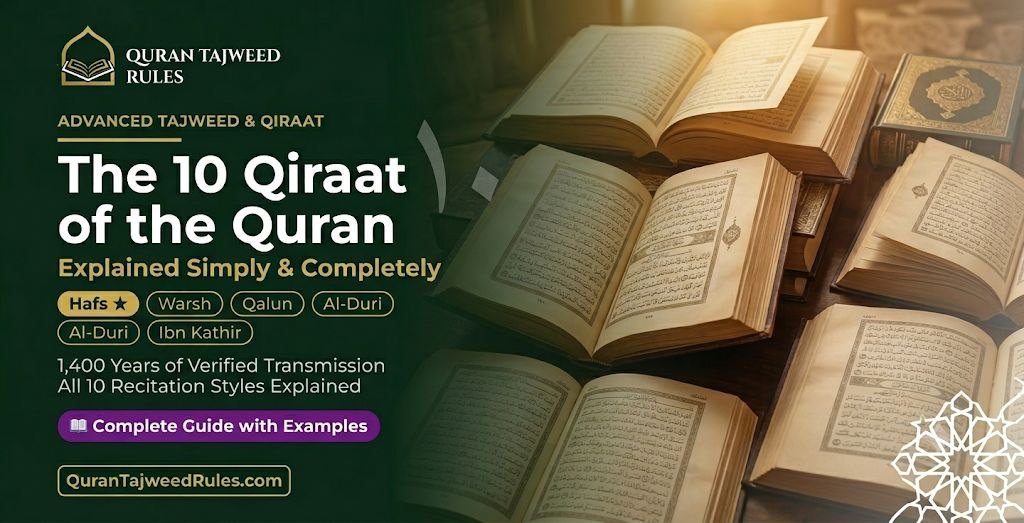
Most Muslims recite the Quran every day without ever encountering the term 10 Qiraat of the Quran — and that is completely normal. The recitation style used in the vast majority of printed Qurans and taught in most Quran classes is just one of these 10 Qiraat. But behind this single familiar style lies an extraordinary tradition: 10 authentic, verified ways of reciting the Quran, each transmitted through its own unbroken chain back to the Prophet Muhammad صلى الله عليه وسلم.
Understanding the 10 Qiraat is not just an academic exercise. It opens a window into how the Quran was revealed, how it was preserved across different regions of the early Islamic world, and how a small number of subtle, beautiful variations in pronunciation and wording have been documented, verified, and protected for over 1,400 years.
This guide explains the 10 Qiraat of the Quran simply and completely — what they are, where they came from, how they differ, why they all remain authentic, and how serious students can pursue certification in them through Quran Tajweed Rules Academy.
|
What You Will Learn in This Guide What the 10 Qiraat of the Quran are and where the term comes from • The historical origin of multiple recitation styles • All 10 Qiraat listed with their reciters and regions • Real examples of how the Qiraat differ • Why all 10 Qiraat are equally authentic • How to study the 10 Qiraat — and the full learning pathway |
What Are the 10 Qiraat of the Quran? A Simple Definition
The 10 Qiraat of the Quran are 10 authentic, verified styles of reciting the Quran, each transmitted through a documented chain of transmission (Isnad) from the Prophet Muhammad صلى الله عليه وسلم. The word Qiraat (قراأات) is the plural of Qira’ah (قراءة), meaning “a way of reciting” or “a reading.”
Put simply: the 10 Qiraat of the Quran are 10 different — but equally authentic — ways of pronouncing certain words, applying certain Tajweed rules, and in some cases reading certain letters in the Quran. The meaning of the Quran is preserved across all 10 Qiraat; what differs are specific pronunciations, vowel patterns, and occasionally word forms that were all revealed and taught by the Prophet صلى الله عليه وسلم himself to different Companions.
|
The Most Important Thing to Understand About the 10 Qiraat The 10 Qiraat of the Quran are not different versions of the Quran, and they are not human innovations or later additions. Each of the 10 Qiraat traces back to the Prophet صلى الله عليه وسلم through a verified chain of transmission. All 10 are considered Mutawatir (transmitted by such a large number of reliable narrators that fabrication is impossible) and are equally authentic and equally the word of Allah. |
What Is the History Behind the 10 Qiraat of the Quran?
Understanding the history of the 10 Qiraat of the Quran explains why multiple authentic recitation styles exist at all.
The Origin: Multiple Revealed Forms
Hadith literature records that the Quran was revealed in Sab’atu Ahruf — “seven forms” or “seven modes” — a concept scholars have interpreted in various ways, but which is widely understood to mean that Allah permitted the Quran to be recited in several authentic variant forms, accommodating the dialectal diversity of the Arabian Peninsula at the time of revelation. The Prophet صلى الله عليه وسلم taught these variant forms to different Companions, who then transmitted them to their own students.
The Spread: Regional Centers of Recitation
As Islam spread across the Arabian Peninsula, Iraq, the Levant, and North Africa, different regions developed strong traditions of Quranic recitation based on which Companions had settled there and which forms of recitation they had transmitted. Over time, scholars in each region became renowned for transmitting a particular, verified style of recitation — the foundation of what would become the 10 Qiraat of the Quran.
The Formalization: Ibn Mujahid and the Canonical Seven
In the 4th century of the Islamic calendar, the scholar Ibn Mujahid formally documented 7 Qiraat that had the strongest and most widely verified chains of transmission, in his influential work establishing these as the canonical “Seven Readings” (Al-Qiraat As-Sab‘). Later scholars added 3 additional Qiraat — also verified through strong Mutawatir chains — bringing the total to the 10 Qiraat of the Quran recognized today.
The Complete List of the 10 Qiraat of the Quran
Here are the 10 Qiraat of the Quran, each named after the Imam (reciter) whose transmission became most associated with that reading, along with the region and a notable feature of each:
|
Qiraat |
Reciter (Imam) |
Region/Tradition |
Notable Feature |
|
1. Hafs |
Hafs ‘An ‘Asim |
Kufa, Iraq |
Most widely practiced worldwide today — used in the standard printed Mushaf |
|
2. Warsh |
Warsh ‘An Nafi‘ |
Madinah → North/West Africa |
Widely used across North and West Africa |
|
3. Qalun |
Qalun ‘An Nafi‘ |
Madinah |
Used in parts of Libya and North Africa |
|
4. Al-Duri |
Al-Duri ‘An Abi ‘Amr |
Basra, Iraq |
Used historically in Sudan and parts of West Africa |
|
5. Al-Susi |
As-Susi ‘An Abi ‘Amr |
Basra, Iraq |
Shares the same Imam (Abu ‘Amr) as Al-Duri, different transmitter |
|
6. Ibn Kathir (Makki) |
Al-Bazzi & Qunbul ‘An Ibn Kathir |
Makkah |
One of the original 7 canonical Qiraat |
|
7. Ibn ‘Amir |
Hisham & Ibn Dhakwan ‘An Ibn ‘Amir |
Damascus, Syria |
Reflects the Levantine recitation tradition |
|
8. Al-Kisa’i |
Al-Kisa’i |
Kufa, Iraq |
One of the original 7 canonical Qiraat |
|
9. Ya’qub |
Ya’qub Al-Hadrami |
Basra, Iraq |
One of the 3 Qiraat added to complete the 10 |
|
10. Khalaf |
Khalaf ‘An Hamzah |
Kufa, Iraq |
One of the 3 Qiraat added to complete the 10 |
Of all 10 Qiraat of the Quran, Hafs ‘An ‘Asim is by far the most widely practiced today — estimated at over 90% of the global Muslim population — because it is the recitation used in the standard Mushaf printed in Saudi Arabia and distributed worldwide. Warsh ‘An Nafi‘ is the second most widely practiced, particularly across North and West Africa.
How Do the 10 Qiraat of the Quran Actually Differ? Real Examples
The differences across the 10 Qiraat of the Quran are best understood through real examples. These differences fall into several categories:
Difference Type 1: Vowel Variations
One of the most common types of variation across the 10 Qiraat of the Quran involves different vowels on the same letters, which can subtly affect meaning or grammatical structure without changing the overall message.
|
Example: Surah Al-Fatiha 1:6 In Hafs: مَالِكِ يَوْمِ الدِّينِ (Maaliki yawmid-deen — “Owner/Master of the Day of Judgment”) In another Qiraat: مَلِكِ يَوْمِ الدِّينِ (Maliki yawmid-deen — “King/Sovereign of the Day of Judgment”) The single vowel difference (مَالِكِ vs مَلِكِ) reflects two related, complementary meanings — both authentic, both transmitted from the Prophet صلى الله عليه وسلم. |
Difference Type 2: Madd Length Variations
Different Qiraat among the 10 Qiraat of the Quran sometimes apply different Madd (elongation) lengths to the same letters. For example, Warsh ‘An Nafi‘ is well known for applying longer Madd — in some cases up to 6 counts where Hafs applies 4-5 — giving Warsh recitation its distinctively flowing, extended sound that listeners familiar primarily with Hafs often notice immediately.
Difference Type 3: Letter Pronunciation Variations
Some differences among the 10 Qiraat of the Quran involve how specific letters are pronounced. A well-known example is the word صِرَاطَ (Siraat) in Surah Al-Fatiha. In Hafs, it is pronounced with ص (Saad). In some other Qiraat, the same word is pronounced with س (Seen) — Siraat with a regular S sound — reflecting a dialectal variation present in the original revelation.
Difference Type 4: Word Form Variations
A smaller number of differences among the 10 Qiraat of the Quran involve slightly different word forms that convey closely related meanings. These differences have been extensively documented by scholars across centuries and do not contradict one another — rather, they often enrich the meaning by presenting complementary dimensions of the same verse.
Why Are All 10 Qiraat of the Quran Considered Equally Authentic?
A natural question for students encountering the 10 Qiraat of the Quran for the first time is: how can there be 10 different ways to recite the same revelation, with all of them being correct?
The Standard of Mutawatir Transmission
Each of the 10 Qiraat of the Quran meets the standard of Tawatur — transmission by such a large number of independent, reliable narrators across generations that the possibility of error or fabrication is effectively eliminated. This is the same standard applied to verify the authenticity of the Quranic text itself. A Qiraat that does not meet this standard is not included among the 10 — it would instead be classified differently (such as Shaadh, meaning an irregular or weakly transmitted reading).
All Trace Back to the Prophet صلى الله عليه وسلم
Every one of the 10 Qiraat of the Quran is documented through a verified Isnad — the same type of chain of transmission discussed in the context of Ijazah — connecting the reciter, through a series of scholars, back to a Companion who received that specific recitation directly from the Prophet صلى الله عليه وسلم. None of the 10 Qiraat were invented by the Imams whose names they bear — each Imam was simply the most prominent and reliable transmitter of a recitation that already existed.
|
Understand the chain of transmission (Isnad) system that verifies both Ijazah certification and the authenticity of each of the 10 Qiraat. |
 What Is Ijazah in Quran? The Complete 7-Part Guide
Differences Do Not Affect Core Meaning or Belief
It is important to emphasize: the differences across the 10 Qiraat of the Quran never contradict Islamic belief, never change a ruling from permissible to forbidden or vice versa, and never alter the fundamental message of any verse. The variations are subtle — vowel differences, Madd lengths, occasional letter pronunciations — that together represent the richness of how the Quran was revealed to accommodate the dialects of the early Arabic-speaking world.
Hafs vs the Other 10 Qiraat of the Quran: What Every Student Should Know
Because Hafs ‘An ‘Asim is the Qiraat used in virtually all Tajweed courses, printed Qurans, and Ijazah certifications most students pursue, it is worth clarifying its place among the 10 Qiraat of the Quran:
Hafs Is One of the 10 — Not Separate From Them
Hafs ‘An ‘Asim is the 1st of the 10 Qiraat of the Quran listed above — it is not a separate or different category. When students complete Tajweed courses and pursue Ijazah “in Hafs,” they are being certified in one specific Qiraat among the 10, with the option to later pursue certification in additional Qiraat if desired.
Why Most Students Start with Hafs
Students begin with Hafs because: it is the Qiraat of the standard printed Mushaf used in most households and mosques worldwide; it is the Qiraat most certified teachers specialize in; and it provides the foundational Tajweed skills — Makharij, Noon Sakinah rules, Madd, Qalqalah, Ghunnah — that transfer directly to studying any of the other 10 Qiraat of the Quran later.
|
The complete process for earning certification in Hafs ‘An ‘Asim — the first and most widely practiced of the 10 Qiraat of the Quran. |
How to Study the 10 Qiraat of the Quran: A Realistic Path
For students who become interested in the 10 Qiraat of the Quran beyond Hafs, here is a realistic path forward:
Foundation First: Master the Essential Tajweed Rules
Before approaching any of the 10 Qiraat of the Quran, a student needs a solid foundation in the essential Tajweed rules that are common across all Qiraat: Makharij Al-Huruf, Noon Sakinah and Tanween rules, Madd, Qalqalah, and Ghunnah. These rules exist in every Qiraat — only their specific application varies. A student without this foundation cannot meaningfully study the variations between Qiraat.
|
The foundational rules that underlie every one of the 10 Qiraat of the Quran — the essential starting point for any serious Tajweed student. Read: qurantajweedrules.com/essential-tajweed-rules-for-beginners |
|
Correct letter articulation — the foundation shared by all 10 Qiraat of the Quran, with subtle variations explored at the advanced level. |
Advanced Study: Deepen Tajweed Mastery
Before specializing in additional Qiraat, students should complete Advanced Tajweed study — covering all Madd types, Sifaat Al-Huruf, and Tafkhim/Tarqiq at a precise level. This advanced foundation makes it significantly easier to understand how and why other Qiraat among the 10 Qiraat of the Quran apply certain rules differently.
Ijazah in Hafs: The Traditional Starting Point
Most students pursuing knowledge of the 10 Qiraat of the Quran begin by earning Ijazah in Hafs ‘An ‘Asim — establishing a verified, certified foundation in the most widely practiced Qiraat before expanding to others.
The 10 Qiraat Course: Comprehensive Study
For the most dedicated students, the 10 Qiraat Course provides structured study of all 10 Qiraat — their unique rules, their differences from Hafs, their historical Isnad chains, and (for those who complete the full requirements) formal Ijazah in multiple Qiraat. This represents one of the highest levels of Quranic scholarship available to a student.
The Complete Learning Pathway to Study the 10 Qiraat of the Quran
At Quran Tajweed Rules Academy, the pathway toward the 10 Qiraat of the Quran is structured and supported at every stage:
|
STEP 1 — Quran Tajweed Course for Beginners Master the essential Tajweed rules shared across all 10 Qiraat of the Quran. What you get: ✓ Complete Makharij Al-Huruf from lesson one ✓ All 7 essential Tajweed rules with Quranic examples ✓ Al-Azhar certified teachers ✓ Free trial class available |
 FOUNDATION
 qurantajweedrules.com/quran-tajweed-course-for-beginners
|
STEP 2 — Advanced Quran Tajweed Rules Course Deepen your Tajweed mastery to the level required for serious Qiraat study. What you get: ✓ All advanced Madd types and Sifaat Al-Huruf ✓ Tafkhim and Tarqiq at advanced precision ✓ Full Surah recitation reviews with senior scholars ✓ 24 hours of advanced one-on-one instruction |
 ADVANCED
|
STEP 3 — Online Ijazah in Hafs Course Earn formal certification in the first and most widely practiced of the 10 Qiraat of the Quran. What you get: ✓ Complete Quran recitation verified by Ijazah-holding Sheikh ✓ Internationally recognized Ijazah certificate and Isnad ✓ Foundation for expanding into additional Qiraat ✓ Available for both Hifz and Nazr pathways |
 CERTIFICATION
|
STEP 4 — 10 Qiraat Course Comprehensive study of all 10 Qiraat of the Quran with senior Al-Azhar scholars. What you get: ✓ All 10 Qiraat: Hafs, Warsh, Qalun, Al-Duri, As-Susi, Ibn Kathir, Ibn ‘Amir, Al-Kisa’i, Ya’qub, and Khalaf ✓ Each Qiraat’s unique rules and verified Isnad chain ✓ Senior Al-Azhar scholars holding Ijazat in multiple Qiraat ✓ Formal Ijazah in multiple Qiraat upon completion |
 MASTERY
Related Guides: Build Toward the 10 Qiraat of the Quran
|
The foundational guide to Tajweed — the rules shared across all 10 Qiraat of the Quran and the starting point for every student. |
|
The 4 rules that appear, with variations, across all 10 Qiraat of the Quran — master them in Hafs before exploring other Qiraat. |
|
Madd length is one of the most noticeable differences across the 10 Qiraat of the Quran — understand the Hafs baseline first. |
|
A realistic timeline for the full journey — from beginner Tajweed through Ijazah and toward studying the 10 Qiraat of the Quran. Read: qurantajweedrules.com/how-long-does-it-take-to-learn-tajweed |
Frequently Asked Questions: The 10 Qiraat of the Quran
Are the 10 Qiraat of the Quran different Qurans?
No. The 10 Qiraat of the Quran are not different Qurans — they are 10 authentic ways of reciting the same revelation, all transmitted from the Prophet صلى الله عليه وسلم through verified chains. The differences are limited to specific pronunciations, vowels, Madd lengths, and occasional word forms — never to the core message, rulings, or beliefs conveyed by the Quran.
Which of the 10 Qiraat of the Quran is the most common today?
Hafs ‘An ‘Asim is by far the most common of the 10 Qiraat of the Quran, used by an estimated 90%+ of Muslims worldwide because it is the recitation of the standard Mushaf printed in Saudi Arabia and distributed globally. Warsh ‘An Nafi‘ is the second most common, particularly in North and West Africa.
Do I need to learn all 10 Qiraat of the Quran?
No — the vast majority of Muslims only ever need Hafs ‘An ‘Asim, since it is the Qiraat used in daily recitation, prayer, and most printed Qurans worldwide. Studying the 10 Qiraat of the Quran comprehensively is an advanced specialization pursued by a small number of dedicated scholars, often those who wish to teach at the highest levels or deepen their personal connection to the full breadth of the Quranic transmission tradition.
Can a beginner start learning about the 10 Qiraat of the Quran?
A complete beginner should not start with the 10 Qiraat of the Quran — the prerequisite is solid mastery of essential and advanced Tajweed in Hafs first. However, learning about the 10 Qiraat — their history, names, and general differences, as covered in this guide — is valuable for any student at any stage, as it provides context for the broader tradition of Quranic preservation.
Is studying the 10 Qiraat of the Quran available online?
Yes. The 10 Qiraat Course at Quran Tajweed Rules Academy is available fully online, with senior Al-Azhar scholars holding Ijazat in multiple Qiraat. As with Ijazah in Hafs, the online format does not diminish the authenticity of the verified chain of transmission — what matters is the live, verified examination by a qualified scholar.
The 10 Qiraat of the Quran: A Tradition Worth Knowing
Now you understand the 10 Qiraat of the Quran: 10 authentic, Mutawatir-verified ways of reciting the Quran, each tracing back through an unbroken chain to the Prophet Muhammad صلى الله عليه وسلم, named after the Imams whose transmissions became most associated with each reading, and differing only in subtle, beautiful, and well-documented ways.
For most Muslims, daily recitation in Hafs ‘An ‘Asim is the right and complete path — and mastering Tajweed in Hafs is itself a lifelong, rewarding pursuit. For the most dedicated students, the journey can extend into the wider tradition of the 10 Qiraat, connecting them to an even broader expression of how the Quran has been preserved across centuries and continents.
Wherever you are on this journey, the path forward starts with a single, free lesson.
|
Begin Your Tajweed Journey Today Whether your goal is mastering Hafs ‘An ‘Asim or eventually exploring the 10 Qiraat of the Quran, Quran Tajweed Rules Academy has the course and certified teachers for every stage. Start with a free trial class — no payment, no commitment. Visit: qurantajweedrules.com/freetrial |
One Response