
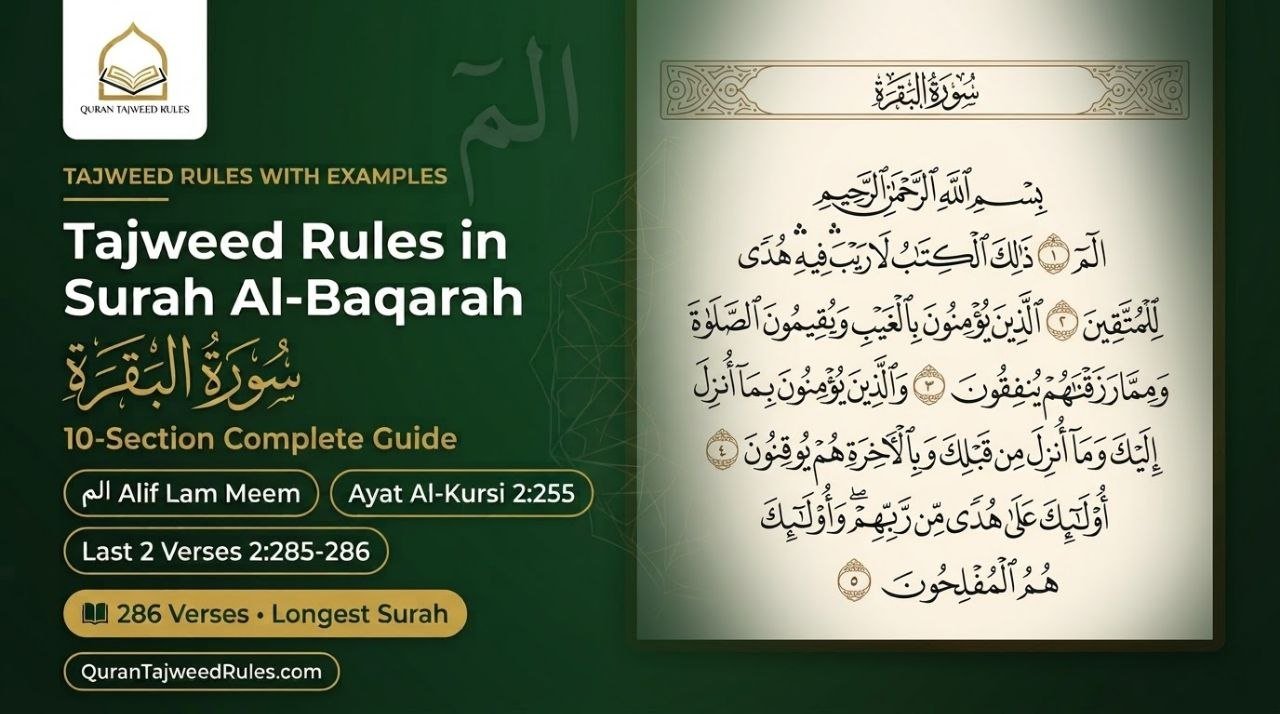
Surah Al-Baqarah is the longest Surah in the Quran — 286 verses spanning 48 pages of the standard Mushaf. For Quran students and reciters, it is also one of the most Tajweed-rich Surahs: a comprehensive collection of every major rule category, appearing repeatedly across its length, in some of the most memorized verses in Islam.
Understanding Tajweed rules in Surah Al-Baqarah is essential because Ayat Al-Kursi (2:255), the last two verses (2:285–286), and the opening letters (2:1) are among the most widely recited passages in the entire Quran. Applying Tajweed correctly in these passages transforms recitation that every Muslim knows well.
|
What You Will Learn The correct Tajweed of Huroof Al-Muqattaʿat (Alif Lam Meem) • Madd Muttasil vs Madd Munfasil distinction • Ayat Al-Kursi — every rule broken down • The last 2 verses complete analysis • 10 most common mistakes corrected • How to use Al-Baqarah as advanced practice |
Section 1: Alif Lam Meem — Tajweed of the Huroof Al-Muqattaʿat (2:1)
The very first Tajweed rule in Surah Al-Baqarah appears in its opening letters — الم (Alif Lam Meem) — the disconnected letters whose Tajweed requires precise understanding:
|
الم Alif — Laam — Meem (each letter recited by its full name) Surah Al-Baqarah 2:1 Tajweed Rules:
|
 ALIF (الف): The letter name Alif consists of: Hamzah + Lam + Fa — three consonants with short vowels. There is NO Madd letter in the name Alif. Therefore: NO Madd applies to Alif here.
|
Madd Lazim Harfi: Muthaqqal vs Mukhaffaf When the Madd letter in a Huroof Al-Muqattaʿat name is followed by a letter with Shaddah (merged/doubled) — the Madd is Muthaqqal (heavy/merged). Example: LAM — the Meem after the Alif Madd has Shaddah. When the Madd letter is followed by a letter with plain Sukoon (no Shaddah) — the Madd is Mukhaffaf (light). Example: MEEM — the final Meem carries plain Sukoon. Both types are held for 6 counts in Hafs ʿAn ʿAsim. |
|
The complete Madd Lazim system — Harfi and Kilmi, Muthaqqal and Mukhaffaf — explained in full. |
 Advanced Tajweed Rules: The Essential 7-Category Guide
Section 2: Verses 1–5 — The Opening Description of the Believers
The opening 5 verses of Al-Baqarah contain important Tajweed rules worth examining carefully:
|
ذٰلِكَ الْكِتَٰبُ لَا رَيْبَ فِيهِ Dhaalik-al-kitaabu laa rayba feeh Surah Al-Baqarah 2:2 Tajweed Rules:
|
|
Ra Rule in Rayba — Correction Ra (ر) in Rayba carries Fatha. The rule: Ra is HEAVY (Mufakhkham) when it has Fatha or Damma, or when it has Sukoon preceded by a Fatha or Damma. Ra is light only in specific Kasra conditions. Rayba: Ra + Fatha → HEAVY Ra. Not light. |
|
وَمِمَّا رَزَقْنَاهُمْ يُنْفِقُونَ Wa mimmaa razaqnaahum yunfiqoon Surah Al-Baqarah 2:3 Tajweed Rules:
|
Section 3: The Fasting Verses (2:183–185)
The Ramadan fasting verses are recited globally during the blessed month. Their Tajweed rules in Surah Al-Baqarah deserve careful attention:
|
يَٰأَيَُّهَا الَّذِينَ آمَنُوا كُتِبَ عَلَيْكُمُ الصِّيَامُ Yaa ayyuhal-ladheen aamanoo kutiba ʿalaykumus-siyaam Surah Al-Baqarah 2:183 Tajweed Rules:
|
|
The 4 Noon Sakinah rules applied throughout Surah Al-Baqarah. |
Section 4: Ayat Al-Kursi — The Most Recited Verse in Al-Baqarah
Ayat Al-Kursi (2:255) is the most widely memorized and recited verse outside Al-Fatiha. Its Tajweed rules in Surah Al-Baqarah have the highest daily impact of any passage:
|
اللَّهُ لَآ إِلَٰهَ إِلَّا هُوَ الْحَيُّ الْقَيُّومُ Allahu laa ilaaha illaa huwal-hayyul-qayyoom Surah Al-Baqarah 2:255 — opening Tajweed Rules:
|
|
Madd Muttasil vs Madd Munfasil — Critical Distinction Madd Wajib Muttasil (مد واجب متصل): The Madd letter AND the Hamzah are in the SAME word. Example: جاء (jaa-a) — Alif + Hamzah in one word. Always 4–5 counts in Hafs. Madd Jaʼiz Munfasil (مد جائز منفصل): The Madd letter is at the END of one word and the Hamzah is at the START of the NEXT word. Example: لَآ إِلَٰهَ — Laa (word 1 ends with Alif Madd) + ilaaha (word 2 starts with Hamzah). 4–5 counts in the narration of Hafs who chooses Tawassut, or 2 counts for those who choose Qasr. Never label Munfasil as Muttasil — they are different rules. |
|
لَهُ مَا فِي السَّمَٰوَٰتِ وَمَا فِي الْأَرْضِ Lahu maa fis-samaawaati wa maa fil-ard Surah Al-Baqarah 2:255 Tajweed Rules:
|
|
وَسِعَ كُرْسِيُّهُ السَّمَٰوَٰتِ وَالْأَرْضَ Wasiʿa kursiyyuhus-samaawaati wal-ard Surah Al-Baqarah 2:255 Tajweed Rules:
|
|
وَلَا يَئُودُهُ حِفْظُهُمَا وَهُوَ الْعَلِيُّ الْعَظِيمُ Wa laa ya-ooduhu hifdhuhumā wa huwal-ʿaliyyul-ʿadheem Surah Al-Baqarah 2:255 — closing Tajweed Rules:
|
Section 5: The Last Two Verses of Al-Baqarah (2:285–286)
The last two verses are among the most memorized passages in Islam. Their Tajweed rules must be applied with full precision:
|
آمَنَ الرَّسُولُ بِمَآ أُنزِلَ إِلَيْهِ مِن رَّبِّهِ Aamanar-rasoolu bimaa unzila ilayhi min rabbih Surah Al-Baqarah 2:285 Tajweed Rules:
|
|
لَا يُكَلِّفُ اللَّهُ نَفْسًا إِلَّا وُسْعَهَا Laa yukallifullahu nafsan illaa wusʿahaa Surah Al-Baqarah 2:286 Tajweed Rules:
|
The Complete Tajweed Rules Reference Table for Key Al-Baqarah Sections
Accurate reference table of the main Tajweed rules in Surah Al-Baqarah:
|
Section / Verses |
Tajweed Rule |
Example & Application |
|
2:1 Alif |
NO Madd |
Alif letter name has no Madd letter — no elongation |
|
2:1 Lam |
Madd Lazim Harfi Muthaqqal (6 counts) |
LAM: Alif Madd + Meem Shaddah = Muthaqqal |
|
2:1 Meem |
Madd Lazim Harfi Mukhaffaf (6 counts) |
MEEM: Ya Madd + Meem plain Sukoon = Mukhaffaf |
|
2:2 |
Madd Asli (2 counts) |
DhAAlik, KitAAb, LAA — multiple Natural Madds |
|
2:2 |
Ra HEAVY in Rayba |
Ra + Fatha = heavy (Mufakhkham) |
|
2:3 |
Ghunnah |
Mimmaa — Shaddah Meem, 2-count nasal |
|
2:3 |
Ikhfa |
Yunfiqoon — Noon Sakinah before Fa |
|
2:255 |
Madd Jaʼiz Munfasil |
LAA ilaaha — Alif (end of word) + Hamzah (start of next) |
|
2:255 |
Lam Al-Jalalah Heavy |
Allahu — preceded by Damma |
|
2:255 |
Makharij ع Ain |
Wasiʿa, Al-ʿaliyyu, Al-ʿadheem — middle throat x3 |
|
2:255 |
Waqf on Al-Ard |
Sukoon on Dad — NO Madd Arid (Dad is not a Madd letter) |
|
2:183 |
Madd Jaʼiz Munfasil |
Yaa ayyuha — Ya Madd (word end) + Hamzah (word start) |
|
2:183 |
Makharij ص Saad |
As-Siyaam — heavy emphatic Saad |
|
2:285 |
Madd Badal (2 counts) |
Aaman — Hamzah substituted by Alif Madd — 2 counts in Hafs |
|
2:285 |
Madd Jaʼiz Munfasil |
bimAA unzila — Alif (word end) + Hamzah (word start) |
|
2:285 |
Idgham without Ghunnah |
min rabbih — Noon before Ra, full merge, no nasal |
|
2:286 |
Lam Al-Jalalah Heavy |
Allahu — preceded by Damma |
|
2:286 |
Madd ʿIwad (Waqf) |
Wusʿahaa — Alif from Tanween Fath = 2 counts at pause |
The 10 Most Common Tajweed Mistakes in Surah Al-Baqarah
- Applying Madd Lazim to Alif in Alif Lam Meem (2:1) — Alif has NO Madd letter in its name. Only Lam and Meem get Madd Lazim (6 counts each).
- Labeling Madd Munfasil as Muttasil — In LAA ilaaha, bimAA unzila, Yaa ayyuha: the Madd letter and Hamzah are in SEPARATE words = Madd Jaʼiz Munfasil, NOT Muttasil.
- Light Ra in Rayba (2:2) — Ra with Fatha is HEAVY (Mufakhkham). Not light.
- Claiming Madd Arid on Al-Ard (2:255) — Dad is NOT a Madd letter. No Madd Arid applies. Correct: Sukoon on Dad with its Sifaat at Waqf.
- Mixing up Ayat Al-Kursi Madd types — multiple Munfasil Madds exist; ensure consistent treatment throughout.
- Light Lam in Allahu after Damma — must be HEAVY when preceded by Fatha or Damma.
- Ain (ع) reduced to plain vowel — in Wasiʿa, Al-ʿaliyyu, Al-ʿadheem — middle-throat voiced articulation required.
- Saad (ص) as regular S — As-Siyaam in 2:183 must be heavy emphatic Saad.
- Missing Idgham without Ghunnah — min rabbih (2:285): Noon merges fully into Ra with no nasal.
- Extending Madd Badal beyond 2 counts — Aaman in 2:285 = 2 counts in Hafs. Not 4 or 6.
Tajweed Principles That Apply Throughout All of Surah Al-Baqarah
1. Madd Muttasil vs Munfasil Throughout
This is the most important Madd distinction in Al-Baqarah. Muttasil: Madd letter + Hamzah in the SAME word (4–5 counts, obligatory). Munfasil: Madd letter at END of one word + Hamzah at START of next word (4–5 or 2 counts, permissible). Al-Baqarah contains both types extensively. Identifying them correctly is essential.
2. Lam Al-Jalalah Alternates Throughout
Allah appears hundreds of times. Each occurrence: HEAVY after Fatha/Damma, LIGHT after Kasra. Automatic recognition across 48 pages comes only through extended practice with a certified teacher.
3. ع (Ain) from Middle Throat Throughout
Ain appears in many words across Al-Baqarah. Consistent middle-throat voiced production across 48 pages is one of the most demanding aspects of Tajweed in Surah Al-Baqarah for non-Arabic speakers.
4. Idgham without Ghunnah Before Ra and Lam
Noon Sakinah or Tanween followed by Ra or Lam = full Idgham without Ghunnah. The merge is seamless with no nasal resonance. Appears many times in Al-Baqarah.
5. Heavy Letters Consistently
The 7 heavy letters (خ ص ض غ ط ق ظ) appear constantly throughout Al-Baqarah. Consistent heaviness, especially for ض (Dad) and ص (Saad), distinguishes advanced from intermediate reciters.
|
The most audible Tajweed rules that appear extensively throughout Surah Al-Baqarah. |
How to Practice Surah Al-Baqarah Tajweed Systematically
Stage 1: Master the Key Passages First
Begin with Alif Lam Meem (2:1), Ayat Al-Kursi (2:255), and the last two verses (2:285–286). Perfect the Tajweed rules in Surah Al-Baqarah in these passages first.
Stage 2: Extend in 10-Verse Blocks
Work through Al-Baqarah in 10-verse sections, mastering each block’s Tajweed before moving on.
Stage 3: Weekly Recitation with a Certified Teacher
The most effective practice is weekly recitation sessions with a certified teacher who identifies consistency errors that only emerge in extended recitation — the approach used in Ijazah preparation.
The Complete Learning Pathway
|
STEP 1 — Quran Tajweed Course for Beginners Master all 7 essential rules before approaching Al-Baqarah at Tajweed level. What you get: ✓ Makharij for all letters including ع, ص, ض, ح, غ ✓ Noon Sakinah and Madd rules — foundation for all Al-Baqarah rules ✓ Free trial class available |
 FOUNDATION
 qurantajweedrules.com/quran-tajweed-course-for-beginners
|
STEP 2 — Advanced Quran Tajweed Rules Course Master Madd Lazim, Madd Munfasil, Lam Al-Jalalah, and all rules for Al-Baqarah. What you get: ✓ Complete Madd system: Muttasil, Munfasil, Lazim, Badal ✓ Lam Al-Jalalah and Ra rules throughout the Quran ✓ Advanced Waqf categories |
 ADVANCED
|
STEP 3 — Online Ijazah in Hafs Course Recite all 286 verses of Al-Baqarah at Ijazah standard with a certified Sheikh. What you get: ✓ Every Tajweed rule in Al-Baqarah verified across all 48 pages ✓ Internationally recognized Ijazah certificate and Isnad |
 IJAZAH
Related Guides
|
Perfect Al-Fatiha Tajweed first — the foundation for every Surah including Al-Baqarah. Read: qurantajweedrules.com/tajweed-rules-in-surah-al-fatiha |
|
Every challenging letter in Al-Baqarah — ع, ح, ص, ض, ظ — explained accurately. |
|
The foundational science behind every rule applied in Surah Al-Baqarah. |
Frequently Asked Questions
What is the Madd in Alif Lam Meem (2:1)?
Alif: No Madd. The letter name Alif contains no Madd letter. Lam: 6 counts — Madd Lazim Harfi Muthaqqal (Alif Madd + Meem Shaddah). Meem: 6 counts — Madd Lazim Harfi Mukhaffaf (Ya Madd + Meem plain Sukoon).
Is LAA ilaaha Madd Muttasil or Munfasil?
Madd Jaʼiz Munfasil. The Alif Madd is at the END of LAA (one word) and the Hamzah is at the START of ilaaha (next word). Munfasil = separate words. 4–5 counts (Tawassut) or 2 (Qasr) in Hafs.
Is there Madd Arid when pausing on Al-Ard?
No. Al-Ard ends with Dad (ض) which is NOT a Madd letter. Madd Arid requires a preceding Madd letter (Alif, Waw with Sukoon, or Ya with Sukoon). At Waqf on Al-Ard: apply Sukoon on Dad and observe its Sifaat. No elongation.
What is the Madd Badal in Aamanar-Rasool (2:285)?
Aamanar: Madd Badal = 2 counts in the Hafs ʿAn ʿAsim riwayah. The original two Hamzahs become Hamzah + Alif Madd (Badal = substitution). In Hafs, this is read with Qasr (shortening) at 2 counts. There is no “0 counts” in Tajweed — Qasr means natural Madd length of 2 counts.
Begin Perfecting Your Surah Al-Baqarah Tajweed Today
Surah Al-Baqarah contains some of the most recited and most spiritually significant verses in the Quran. Applying Tajweed rules in Surah Al-Baqarah correctly — with accurate understanding of Madd Muttasil vs Munfasil, correct Huroof Al-Muqattaʿat Madd, and precise Makharij — is one of the most meaningful Tajweed improvements a serious reciter can make.
|
Book Your Free Trial Class Have your Surah Al-Baqarah Tajweed assessed by a certified Al-Azhar teacher. Every rule identified. Every mistake corrected. First class completely free Visit:qurantajweedrules.com/freetrial |