
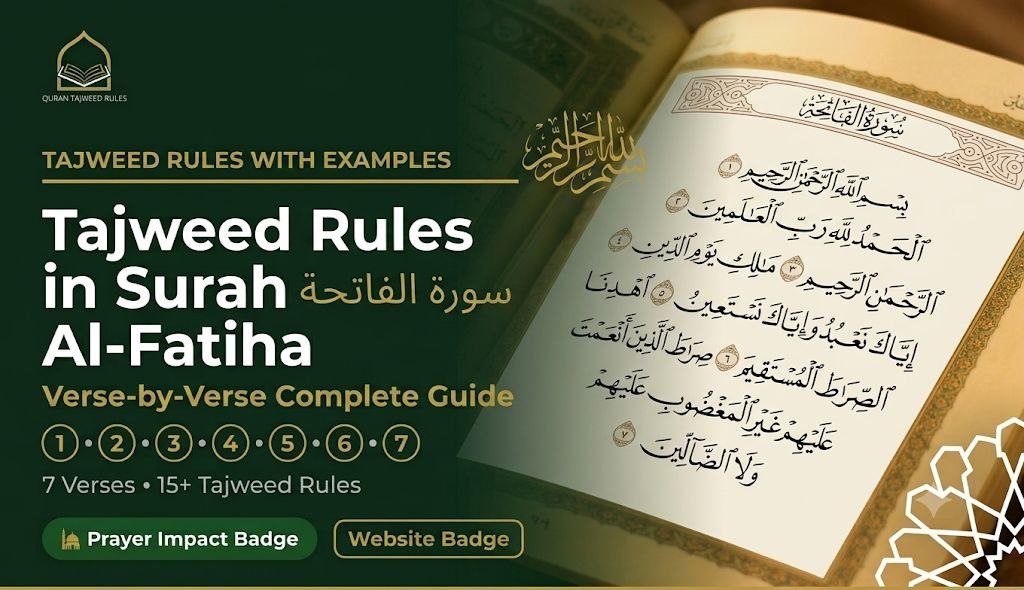
Of all the Quranic text a Muslim recites in their lifetime, nothing is recited more than Surah Al-Fatiha — seventeen times daily in obligatory prayer alone. Yet most Muslims have never had its Tajweed rules in Surah Al-Fatiha explained to them verse by verse.
Surah Al-Fatiha’s 7 verses contain clear examples of Makharij precision, Natural Madd (Madd Asli), Madd Lazim, Izhar Halqi, Ghunnah, Lam Al-Jalalah, Tafkhim, and Waqf rules. This guide explains every rule accurately and completely.
What You Will Learn Correct verse numbering in the Hafs riwayah • Every Tajweed rule per verse • Accurate Makhraj descriptions • Common mistakes corrected • Complete Waqf guide • 5-week practice plan |
Verse Numbering in the Hafs ʿAn ʿAsim Riwayah
In the Hafs ʿAn ʿAsim riwayah — the most widely practiced Qiraat worldwide — Bismillah Al-Rahman Al-Raheem is Verse 1 of Surah Al-Fatiha. The 7 verses are:
- Verse 1: Bismillah Al-Rahman Al-Raheem
- Verse 2: Al-Hamdu Lillahi Rabbil ʿAalameen
- Verse 3: Al-Rahman Al-Raheem
- Verse 4: Maaliki Yawmid-Deen
- Verse 5: Iyyaka Naʿbudu wa Iyyaka Nastaʿeen
- Verse 6: Ihdinas-Siraatal-Mustaqeem
- Verse 7: Siraatal-Ladheen Anʿamta ʿAlayhim Ghayril-Maghdoobi ʿAlayhim Walad-Daaalleen
Complete Tajweed Rules Reference Table
Accurate reference table of all Tajweed rules in Surah Al-Fatiha:
Verse | Tajweed Rule | Application |
V.1 Bismillah | Lam Al-Jalalah LIGHT | Meem before Allah has Kasra → Lam is light |
V.1 Bismillah | Madd Asli — 2 counts | Al-RaHMAAn: Alif after Ra |
V.1 Bismillah | Madd Asli — 2 counts | Al-RaHEEM: Ya before Meem |
V.1 Bismillah | Ghunnah | Shaddah Meem in Al-RaHEEM: 2-count nasal resonance |
V.2 Al-Hamdu | Lam Al-Jalalah LIGHT | Lillahi: Lam preceded by Kasra → light |
V.2 Al-Hamdu | Makharij: ح (Ha) | Al-HAmdu: Wasatul Halq (middle throat) — Mahmus (unvoiced) |
V.2 Al-Hamdu | Makharij: ع (Ain) | Al-ʿAAlameen: Wasatul Halq — Majhur (voiced) |
V.2 Al-Hamdu | Madd Asli — 2 counts | Al-ʿAAlameen: Alif after ʿAin |
V.3 Al-Rahman | Madd Asli — 2 counts | Al-RaHMAAn: same as V.1 |
V.3 Al-Rahman | Madd Asli — 2 counts | Al-RaHEEM: same as V.1 |
V.4 Maaliki | Madd Asli — 2 counts | MAAlik: Alif after Meem |
V.4 Maaliki | Madd Leen (Waqf only) | Yawm: Waw Sakinah after Fatha — 2/4/6 at pause only |
V.5 Iyyaka | Makharij: ع (Ain) | Naʿbudu: Wasatul Halq — voiced pharyngeal |
V.5 Iyyaka | Short vowels only | Naʿbudu: Ba and Dal have short Harakat. NO Waw Madd. |
V.5 Iyyaka | Makharij: ع (Ain) | Nastaʿeen: Wasatul Halq — second Ain |
V.5 Iyyaka | Madd Asli — 2 counts | NastaʿEEN: Ya before Noon |
V.6 Ihdina | Makharij: ص (Saad) | As-Siraat: Istiʿla + Itbaq — heavy emphatic, NOT regular S |
V.6 Ihdina | Tafkhim | Saad is permanently heavy (Mufakhkham) |
V.6 Ihdina | Madd Asli — 2 counts | As-SirAAT: Alif after Saad |
V.6 Ihdina | Makharij: ق (Qaf) | Al-Mustaqeem: Aqsal Lisaan (back of tongue) |
V.6 Ihdina | Madd Asli — 2 counts | Al-MusTaqEEM: Ya before Meem |
V.7 Siraat | Izhar Halqi | Anʿamta: Noon Sakinah before ع (throat letter) → clear Noon |
V.7 Siraat | Makharij: ع (Ain) | Anʿamta + ʿAlayhim: Wasatul Halq — two Ains |
V.7 Siraat | Makharij: غ (Ghain) | Ghayri: Adna al-Halq (upper throat) — voiced uvular |
V.7 Siraat | Makharij: ض (Dad) | Al-Maghdoobi + Ad-Daaalleen: lateral emphatic |
V.7 Siraat | Madd Lazim — 6 counts | Ad-DAAAlleen: Alif + Shaddah Lam → exactly 6 counts |
V.7 Siraat (Waqf) | Madd Arid | Pausing on Ad-Daaalleen: 2, 4, or 6 counts consistently |
ALL verses | NO Qalqalah | Qalqalah letters (قطبجد) do not carry Sukoon anywhere in Al-Fatiha |
Verse-by-Verse Tajweed Rules in Surah Al-Fatiha
Verse 1 بِسْمِ اللَّهِ الرَّحْمَٰنِ الرَّحِيمِ Bismillahi Al-Rahmani Al-Raheem In the name of Allah, the Most Gracious, the Most Merciful Tajweed Rules:
|
 Lam Al-Jalalah (LIGHT): The Meem in Bismi carries Kasra → Lam in Allah is LIGHT. Sound: bis-mi-llāhi (soft Lam).
Common Mistake in Verse 1 Most reciters produce the Lam in Allah as HEAVY. Incorrect — Kasra precedes it. Wrong: Bismi-LLAH (heavy Lam) Correct: Bismi-llah (light, soft Lam) |
Verse 2 الْحَمْدُ لِلَّهِ رَبِّ الْعَالَمِينَ Al-Hamdu lillahi rabbil ʿaalameen All praise is due to Allah, Lord of all the worlds Tajweed Rules:
|
Key distinction — Ha vs Ain: Both ح (Ha) and ع (Ain) come from the MIDDLE of the throat (Wasatul Halq). What separates them is voicing: ح has Hams (no voicing, just breath) while ع has Jahr (fully voiced). Note: ه (Ha) and ء (Hamzah) come from the LOWEST throat (Aqsal Halq). خ (Kha) and غ (Ghain) come from the UPPER throat (Adna al-Halq).
The complete, accurate guide to all 17 Makharij — including the three throat positions used in Al-Fatiha. |
 Makharij Al-Huruf: 17 Arabic Letter Articulation Points
Verse 3 الرَّحْمَٰنِ الرَّحِيمِ Al-Rahmani Al-Raheem The Most Gracious, the Most Merciful Tajweed Rules:
|
Verse 4 مَالِكِ يَوْمِ الدِّينِ Maaliki Yawmid-Deen Master of the Day of Judgment Tajweed Rules:
|
Verse 5 إِيَّاكَ نَعْبُدُ وَإِيَّاكَ نَسْتَعِينُ Iyyaka naʿbudu wa iyyaka nastaʿeen You alone we worship and You alone we ask for help Tajweed Rules:
|
Critical Correction: Naʿbudu A common error: treating the Damma on Ba in Naʿbudu as a Waw Madd and elongating it. This is INCORRECT and constitutes a Tajweed error (Lahn Al-Khafi). Wrong: Na-ʿBUUUdu (elongated Waw sound) Correct: Na-ʿbu-du (three short syllables, no elongation) Only a Waw that is itself a letter with Sukoon following a Fatha creates a Madd. A Damma vowel on a consonant does NOT produce Madd. |
The 4 Noon Sakinah rules — including Izhar Halqi applied in Verse 7 of Al-Fatiha. |
Verse 6 اهْدِنَا الصِّرَاطَ الْمُسْتَقِيمَ Ihdinas-siraatal-mustaqeem Guide us to the straight path Tajweed Rules:
|
Most Impactful Makhraj Correction in Al-Fatiha The Saad (ص) in As-Siraat is the most frequently mispronounced letter. Its Sifaat: Hams, Shiddah, Istiʿla, Itbaq, Ismat. Wrong: Ih-di-nas-si-raa-tal (flat S) Correct: Ih-di-nas-Sˤ-raa-tal (heavy Saad with back-tongue raising) |
Verse 7 صِرَاطَ الَّذِينَ أنْعَمْتَ عَلَيْهِمْ غَيْرِ الْمَغْضوبِ عَلَيْهِمْ وَلَا الضَّآلِّينَ Siraatal-ladheen anʿamta ʿalayhim ghayril-maghdoobi ʿalayhim walad-daaalleen The path of those upon whom You bestowed favour, not of those who earned anger nor of those who went astray Tajweed Rules:
|
Madd Lazim — The Most Distinctive Rule in Al-Fatiha Ad-DAAAlleen: Alif Madd followed by Shaddah Lam = compulsory 6 counts. Wrong: wa-lad-daa-leen (2–3 counts) Correct: wa-lad-dAAAAAAAA-leen (exactly 6 full counts) Count on fingers: 1-2-3-4-5-6 while holding. Any shorter is a Tajweed error. |
The Throat Letters in Surah Al-Fatiha: Accurate Makhraj Map
Al-Fatiha contains 4 throat letters, each from a specific throat position. Here is the accurate map:
Aqsal Halq (Lowest Throat) — ء Hamzah and ه Ha Location: deepest part of the throat, near the larynx. Letters in Al-Fatiha: ه in Ihdinā (Verse 6) — Ha from lowest throat, soft and open. |
Wasatul Halq (Middle Throat) — ح Ha and ع Ain Location: middle of the pharynx. In Al-Fatiha: • ح (Ha): Al-HAmdu (V.2) — middle throat, UNVOICED (Hams) • ع (Ain): Al-ʿAAlameen (V.2), Naʿbudu, Nastaʿeen (V.5), Anʿamta, ʿAlayhim x2 (V.7) — middle throat, VOICED (Jahr) |
Adna al-Halq (Upper Throat / Uvular Area) — خ Kha and غ Ghain Location: upper throat, near the uvula. In Al-Fatiha: غ (Ghain) in Ghayri (V.7) — upper throat, voiced uvular fricative. |
Complete Waqf Guide for Surah Al-Fatiha
- After V.1 Bismillah: continue in connected recitation (no Waqf sign)
- After V.2 Al-ʿAalameen: Waqf Tam (م) — full recommended stop
- After V.3 Al-Raheem: Waqf Kafi — sufficient stop, permitted
- After V.4 Yawmid-Deen: Waqf Kafi — permitted
- After V.5 Nastaʿeen: Waqf Kafi — permitted
- After V.6 Al-Mustaqeem: Waqf Tam — full stop recommended
- After V.7 Ad-Daaalleen: Waqf Tam — end of Surah, complete stop
The 7 Most Common Tajweed Mistakes in Surah Al-Fatiha
Mistake 1: Heavy Lam in Bismillah (Verse 1)
Error: Heavy Lam in Allah after Kasra. Correction: Kasra precedes → LIGHT Lam.
Mistake 2: Shortening Madd Lazim in Ad-Daaalleen (Verse 7)
Error: 2–3 counts instead of 6. Correction: Exactly 6 counts — no more, no less.
Mistake 3: Dropping ع (Ain) to a Vowel
Error: Ain in Naʿbudu, Anʿamta, ʿAlayhim reduced to plain vowel. Correction: Middle-throat voiced constriction every time.
Mistake 4: Light Saad in As-Siraat (Verse 6)
Error: Regular S instead of heavy ص. Correction: Istiʿla + Itbaq — raise back of tongue, seal to palate.
Mistake 5: Missing Izhar in Anʿamta (Verse 7)
Error: Noon merged into Ain, producing ‘a-amta’. Correction: Clear distinct Noon BEFORE the Ain: An-ʿamta.
Mistake 6: Prolonging Damma in Naʿbudu (Verse 5)
Error: Stretching Damma on Ba into a Waw Madd. Correction: Naʿbudu has short vowels only. Recite briskly: Na-ʿbu-du.
Mistake 7: Inconsistent Madd Asli Lengths
Error: Different Madd lengths for Al-Rahman in V.1 vs V.3. Correction: Set 2-count baseline and hold it identically throughout.
5-Week Daily Practice Plan
- Week 1 — Makharij: Focus on ع, ح, ص, ض, غ in every recitation.
- Week 2 — Madd: Count every Natural Madd (2 counts). Confirm Madd Lazim (6 counts) in Ad-Daaalleen.
- Week 3 — Izhar: Ensure clear Noon in Anʿamta before Ain.
- Week 4 — Lam Al-Jalalah: Light in Bismillah/Lillahi. Heavy only when Fatha/Damma precede.
- Week 5+ — Full integration: all rules simultaneously. Record yourself and review.
The Complete Learning Pathway
STEP 1 — Quran Tajweed Course for Beginners Build correct Makharij and all 7 essential rules from lesson one. What you get: ✓ Makharij for all 29 letters including ع, ح, ص, ض, غ ✓ Noon Sakinah, Madd, Ghunnah and all 7 rules ✓ Al-Fatiha assessment in your very first lesson ✓ Free trial class available |
 BEGINNER
 qurantajweedrules.com/quran-tajweed-course-for-beginners
STEP 2 — Advanced Quran Tajweed Rules Course Master Madd Lazim, Sifaat Al-Huruf, and all advanced rules. What you get: ✓ Complete Madd system including Madd Lazim and Madd Arid ✓ Full Sifaat Al-Huruf for all 29 letters ✓ Full Waqf categories across the Quran |
 ADVANCED
STEP 3 — Online Ijazah in Hafs Course Have every rule verified across all 30 Juz by a certified Sheikh. What you get: ✓ Complete Quran recitation at Ijazah standard ✓ Internationally recognized Ijazah certificate and Isnad |
 IJAZAH
Related Guides
The foundational science behind every rule in Surah Al-Fatiha. |
All 7 rules present in Al-Fatiha — complete overview with examples. Read: qurantajweedrules.com/essential-tajweed-rules-for-beginners |
Deep dive including the Madd Lazim in Ad-Daaalleen. |
Frequently Asked Questions
Is there Qalqalah in Surah Al-Fatiha?
No. The Qalqalah letters (قطبجد) do not appear with Sukoon in Al-Fatiha. Any source claiming Qalqalah in Al-Fatiha is incorrect.
What is the Makhraj of ع (Ain) and ح (Ha)?
Both come from the MIDDLE of the throat (Wasatul Halq). The difference: ع (Ain) is Majhur (voiced), ح (Ha) is Mahmus (unvoiced). They are NOT from the same position as ه (Ha) and ء (Hamzah) which are from the lowest throat (Aqsal Halq).
Is Bismillah a verse of Al-Fatiha?
In the Hafs ʿAn ʿAsim riwayah, Bismillah is counted as Verse 1 of Surah Al-Fatiha. The 7 verses run from Bismillah (V.1) through Ad-Daaalleen (V.7).
Is prayer valid with Tajweed mistakes?
Scholars distinguish Al-Lahn Al-Jali (errors changing meaning — may affect validity) from Al-Lahn Al-Khafi (subtle imprecision — does not invalidate prayer but is an obligation to correct). A certified teacher identifies which category your errors fall into.
Perfect Your Al-Fatiha Recitation Today
You now have a complete, scientifically accurate guide to every Tajweed rule in Surah Al-Fatiha. The next step is having a certified teacher hear your specific recitation and correct what only a trained ear can identify.
Book Your Free Trial Class Al-Fatiha Tajweed assessment by a certified Al-Azhar teacher. First class completely free. Visit: qurantajweedrules.com/freetrial |