
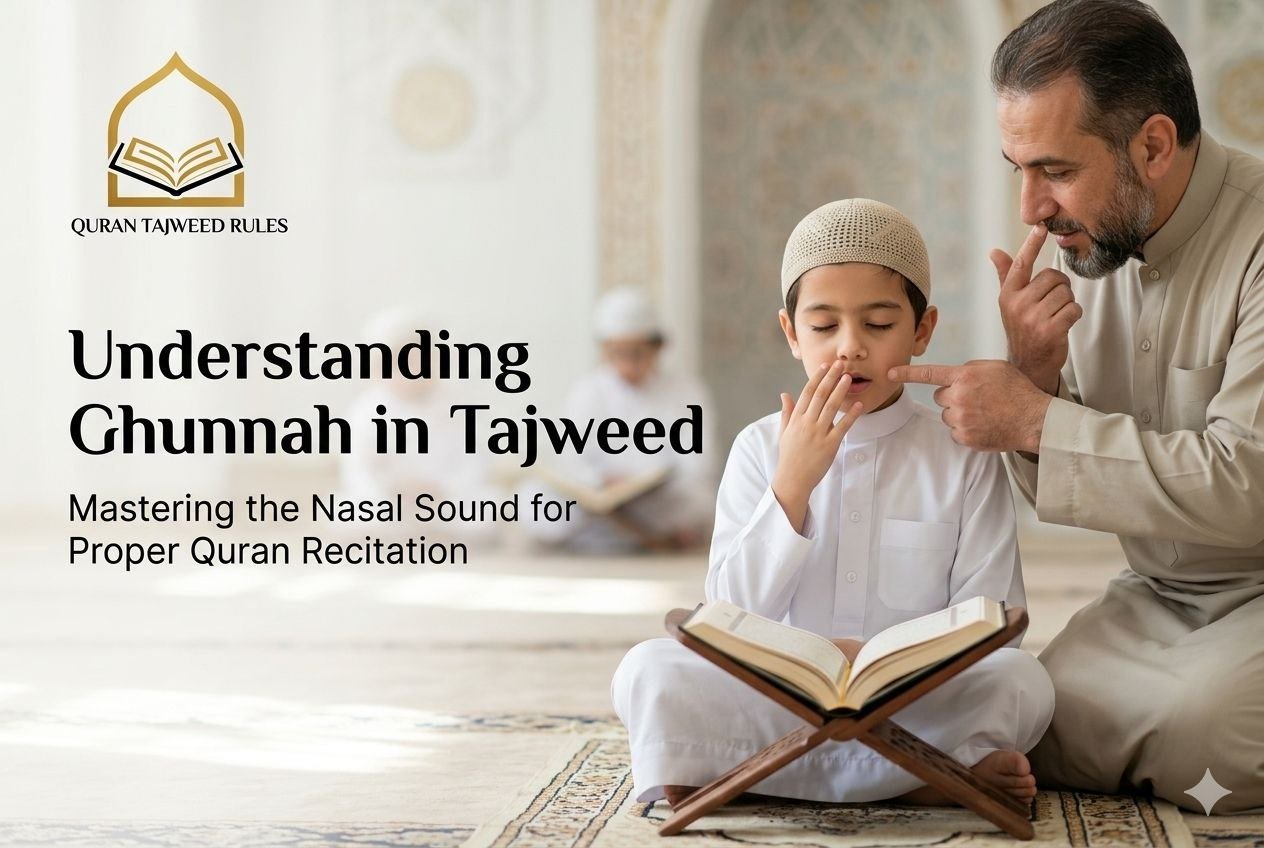
Understanding Ghunnah in Tajweed
One of the most beautiful and recognizable sounds in Quran recitation is Ghunnah. It is a soft nasal sound that comes from the nasal passage (Al-Khayshoom). When applied correctly, Ghunnah adds smoothness and harmony to recitation.
The word Ghunnah means “nasal sound.” It is not produced from the mouth or throat, but from the nose. You can feel it clearly when pronouncing the letters Noon (ن) and Meem (م) with emphasis.
Where Does Ghunnah Occur?
Ghunnah appears mainly in the letters:
- ن (Noon)
- م (Meem)
However, it is not applied in every situation. There are specific cases where Ghunnah becomes required.
1️⃣ Noon and Meem with Shaddah ( ّ )
When Noon or Meem has a shaddah (double letter), Ghunnah must be pronounced clearly for two counts.
Examples:
- إِنَّ
- ثُمَّ
In these cases, the nasal sound is strong and clear.
2️⃣ In Some Noon and Meem Rules
Ghunnah also appears in certain Tajweed rules such as:
- Idgham with Ghunnah
- Ikhfa
- Iqlab
- Ikhfa Shafawi
In these situations, the nasal sound is applied for two counts, but the strength may vary slightly depending on the rule.
How Long Is Ghunnah?
The standard length of Ghunnah is two counts (harakatayn).
A helpful tip:
Count evenly in your heart while maintaining a steady nasal tone — not too long and not too short.
Common Mistakes in Ghunnah
- Making it too short
- Exaggerating the nasal sound
- Producing it from the mouth instead of the nose
- Ignoring it completely
A proper Ghunnah should be smooth and controlled.
Why Is Ghunnah Important?
- It preserves correct Tajweed
- It improves fluency and rhythm
- It beautifies recitation
- It ensures accuracy in merging and hiding letters
Without Ghunnah, certain Tajweed rules would sound incomplete.
How to Practice Ghunnah
- Close your mouth gently and feel the vibration in your nose
- Practice holding the sound for two steady counts
- Compare recitation with experienced Qaris
- Record yourself and review
Final Thoughts
Ghunnah may seem like a small detail, but it plays a major role in Tajweed. When applied correctly, it brings balance and beauty to Quran recitation.
With consistent practice, mastering Ghunnah becomes natural — and your recitation becomes smoother and more confident.

Yo, I’ve had some decent runs over at rr88com. It’s got a pretty solid selection, and I haven’t had any problems cashing out. Worth checking out, for sure. Hit them up here: rr88com