
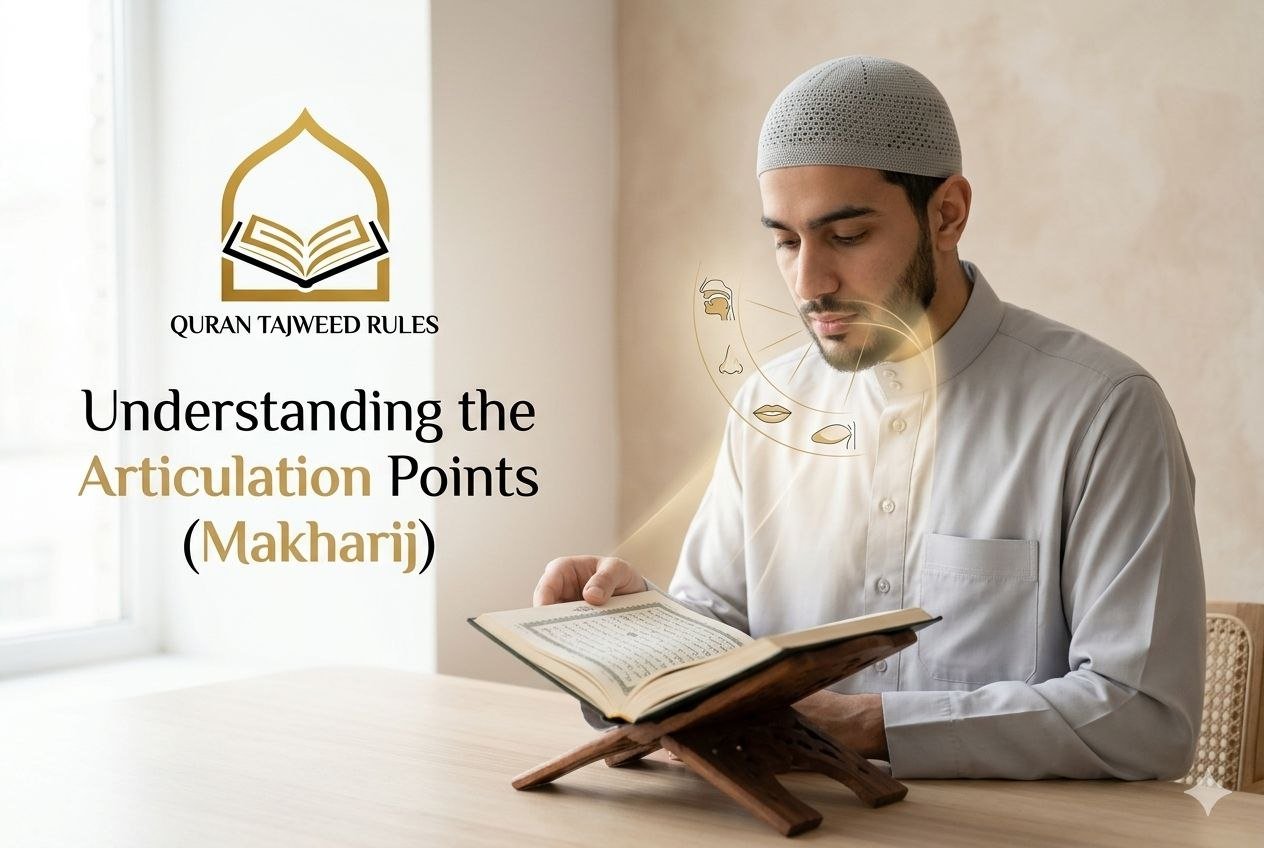
Understanding the Articulation Points (Makharij)
One of the most important foundations of Tajweed is learning the Makharij — the articulation points of Arabic letters. The word Makhraj (plural: Makharij) means the place from which a letter exits when pronounced. Mastering these points ensures that each letter is recited clearly and correctly.
Without proper Makharij, letters can sound similar and change meanings. For example, mixing up س (Seen) and ص (Saad) or ق (Qaf) and ك (Kaaf) can alter the word entirely. This is why scholars consider Makharij the first step in learning Tajweed.
The Five Main Areas of Articulation
Scholars classify Makharij into five primary regions:
1️⃣ The Oral Cavity (Al-Jawf)
This area produces the long vowel letters:
- ا (Alif Madd)
- و (Waw Madd)
- ي (Ya Madd)
These letters are stretched and do not rely on a specific tongue or lip position.
2️⃣ The Throat (Al-Halq)
The throat has three sections:
- Deep throat: ء (Hamzah), ه (Ha)
- Middle throat: ع (‘Ayn), ح (Haa)
- Upper throat: غ (Ghayn), خ (Khaa)
These letters require careful throat control, especially for non-native Arabic speakers.
3️⃣ The Tongue (Al-Lisaan)
Most Arabic letters come from different parts of the tongue. For example:
- Back of the tongue: ق (Qaf), ك (Kaaf)
- Middle of the tongue: ج (Jeem), ش (Sheen), ي (Ya non-Madd)
- Tip of the tongue: ت (Ta), د (Dal), ط (Taa)
- Sides of the tongue: ض (Dhad)
The tongue plays the largest role in pronunciation.
4️⃣ The Lips (Ash-Shafataan)
Letters produced from the lips include:
- ف (Fa)
- ب (Ba)
- م (Meem)
- و (Waw non-Madd)
Lip positioning is essential for clarity.
5️⃣ The Nasal Passage (Al-Khayshoom)
This area produces the nasal sound called Ghunnah, which appears in certain Noon and Meem rules.
Why Makharij Matter
Correct articulation:
- Prevents major pronunciation errors
- Preserves the meaning of verses
- Builds confidence in recitation
- Forms the base for all other Tajweed rules
If Makharaj are weak, advanced Tajweed rules will also be weak.
How to Improve Your Makharij
- Learn from a qualified teacher
- Practice slowly and clearly
- Use a mirror to observe mouth movement
- Record and compare your recitation With Expert Sheikh
- Focus on one group of letters at a time
Final Thoughts
Makharij are the foundation of beautiful Quran recitation. Before learning advanced rules, ensure that every letter comes from its correct place.
Strong articulation leads to strong Tajweed — and strong Tajweed leads to a deeper connection with the words of Allah.
You Can Check Quran Tajweed Course for Beginners

13 Responses